Buffing

Quick answer: In car polishing, "buffing" is everyday shorthand for machine polishing -- running a powered polisher fitted with a foam or microfibre pad and an abrasive polish over the paint to lift gloss and soften light marks. Same job, two names; "mopping" is a third.
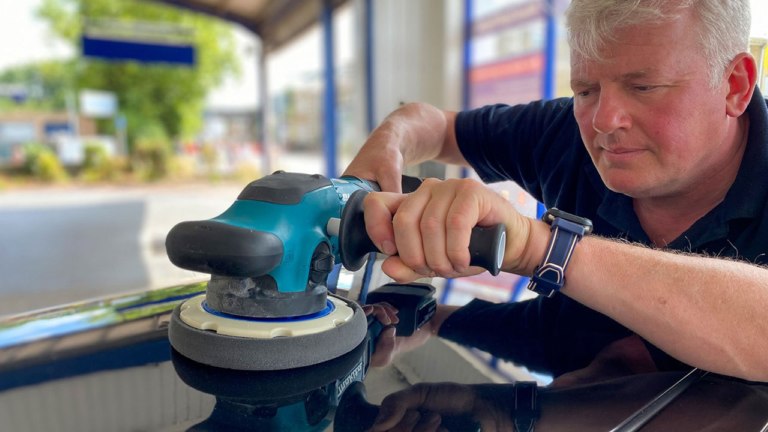
If somebody offers to "give it a buff", they almost always mean a machine polish, not a wipe-over by hand. The word travels with the kit: the foam discs that clip onto a polisher are widely called buffing pads, and a light gloss-up of tired paint gets called "a quick buff". So buffing, machine polishing and mopping are effectively the same act described in three registers -- trade slang, technical term, and old-bodyshop habit.
What "buffing" actually does to the paint
Your car's colour sits under a clear layer called the clearcoat, usually somewhere between 40 and 60 microns thick on a modern factory finish -- thinner than a sheet of kitchen foil. Washing, drying and the weather leave that clearcoat covered in fine scratches that all reflect light in slightly different directions; that scatter is what reads as dullness, haze and the cobweb pattern you see under a low sun. Buffing works by using an abrasive polish and a spinning pad to shave off the very tops of those scratches, levelling the surface so light bounces back more cleanly. The paint looks deeper and glossier not because anything was added, but because a few microns of clear were taken away and smoothed.
That is the part people miss. Every buff removes material you can never put back. Done with judgement it costs you a microscopic amount of clearcoat for a big jump in gloss; done carelessly, with too aggressive a pad-and-polish pairing or too long in one spot, it eats clearcoat you can ill afford to lose -- and on a panel edge it can cut straight through to primer.
A light buff and full correction are not the same thing
This is where the casual word causes most of the trouble on a quoting menu. "Buffing" gets used to describe two very different jobs that happen to use the same machine.
A finishing buff -- sometimes called an enhancement polish -- is a one-stage pass with a soft pad and a mild polish. It chases gloss and knocks back light wash marks and holograms; it will not remove deeper scratches, because doing so would mean cutting far more clearcoat than is wise. This is what most people picture when they think "give the car a buff before it goes on the forecourt".
Full paintwork correction is a different animal: a measured, multi-stage process that starts with a cutting pad and an aggressive compound to actually remove defects, then steps down through finer pads and polishes to refine away the marks the cutting stage itself leaves behind. We measure clearcoat thickness with a paint depth gauge before we start and check it as we go, precisely because correction spends the clearcoat budget that a finishing buff barely touches. Both are "buffing" in the loose sense; they are worlds apart in time, skill and risk.
Why letting "someone with a polisher" do it goes wrong
Machine buffing looks deceptively simple from the doorway -- press pad to panel, move it about, watch the shine come up. The failure modes only show up afterwards, usually under direct sun. The classic one is holograms: faint curved buffing trails left by a rotary polisher in the hands of someone who hasn't learned to break the polish down fully and finish on a soft pad. Then there are fresh swirl marks from a dirty or worn pad dragging grit across the clearcoat, and the worst case -- a burn-through on a ridge, bonnet edge or wing mirror base, where the clearcoat is thinnest and the heat builds fastest. A burn-through is not a polishing problem; it is a respray.
Tom, our operations manager, keeps a bonnet in the corner of the unit that came in after a mobile valeter "buffed" it with a rotary and a single cutting pad to save time. The flat of the bonnet looked glorious for a day; the leading edge had gone matte-grey where the clear had been spun off entirely, and the only fix was paint. We use it to show people the difference between a job that looks finished and one that is actually safe. The kit was cheap; the lesson wasn't.
What proper buffing actually involves
The reason a good machine polish takes us hours rather than minutes is the prep and the control around the buffing itself. Before a pad touches paint the car is washed and the surface is decontaminated, because dragging bonded fallout under a pad is a guaranteed way to add scratches. The work happens in a temperature-controlled unit with proper lighting -- a buff judged under a workshop strip light flatters you and hides exactly the holograms a customer will spot on their driveway. Pads are swapped and cleaned constantly; a loaded or hardening pad stops cutting evenly and starts marring. Polish is worked through its full cycle so the abrasives break down to a fine finish rather than being wiped off half-used.
If you are weighing up doing it yourself, that is the honest picture: a decent dual-action machine, a graded set of pads, the right polishes, a depth gauge, controlled lighting and the experience to read what the paint is telling you as you go. Plenty of enthusiasts get there and enjoy the process. For most people handing the car back at lease-end or prepping it for sale, the maths points the other way -- the gap between a confident finishing buff and an expensive mistake is narrower than it looks.
Common mistakes
- Assuming buffing means wiping wax on and off by hand, when it really means machine polishing.
- Expecting a quick buff to erase deep scratches or stone chips that genuinely need paint.
- Selling heavy correction as "a buff" without explaining what the work actually includes.
- Letting an untrained hand loose with a cheap rotary, which is how you get holograms, fresh swirls or a burned-through edge.