
Tears
Quick answer: Tears are rips or holes in a fabric convertible roof, usually along fold lines where the material has worn thin, and once they appear the roof often needs repair or replacement rather than just a simple clean.
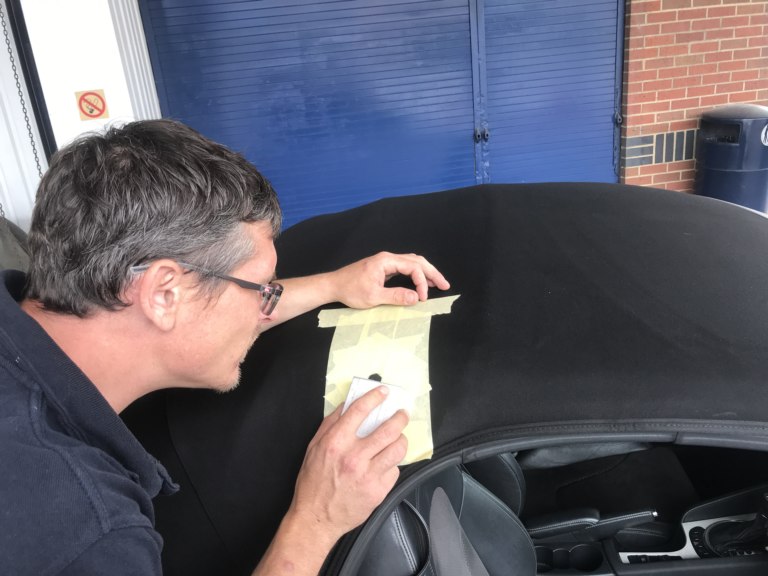
Most tears in roofs are caused by wear along the fold lines. Where one fold meets another, there is a higher likelihood that the fabric will wear through and cause a hole to be torn in the fabric.
If the hole is caught early enough, it can be patched from the other side if it is accessible. However, the repairs are not invisible.
It is usually advisable that if you get tears in your fabric roof, to replace the roof rather than repair because repairing roofs isn't economically viable on modern cars.
It might be the case on vintage cars that you would have a trimmer remove the roof and put it on a sewing machine, but even for vintage cars, roof sets are usually available, so if the roof needs to be removed from the frame it is as well to replace it with a new one.
What it means
Tears are areas where the fabric of a convertible roof has ripped through, leaving a hole or split in the material. They most often appear along the lines where the roof folds when it is lowered, or in places where the cloth has been weakened by grit, rubbing and long-term wear. A tear may be a small slit that has just broken through, or a more obvious hole where the fabric has completely given up.
Why it matters
- Direct route for water and dirt: Even a small tear is an open path into the layers of the roof and, in many cases, straight into the cabin, leading to damp, staining and mould.
- Sign the roof is worn out: Tears usually appear after a period of visible wear marks and thinning, which means the surrounding fabric is often tired as well, not just the spot you can see.
- Repairs are rarely invisible: Patches and stitched repairs can restore function, but they nearly always remain visible close up, especially on modern, tight-fitting hoods.
- Affects value and inspection reports: Obvious tears in a soft top are noted in appraisals and can significantly reduce the car’s appeal and resale value.
Where you’ll see it
You will see tears most often on fabric and mohair soft tops that have lived outside, especially along fold lines, around the rear window and on the shoulders of the roof. Inspection and detailing reports may note small tear at fold, tear developing along wear line or roof torn, recommend replacement. On vintage and classic cars, tears may also appear in older duck hooding that has dried, shrunk or rotted with age.
Context
Tears are usually the end result of long-term contamination and wear. Grit embedded in the fabric, repeated folding of the roof and constant flexing in the wind all thin the fibres until the cloth finally gives way. Once a tear is present, simply cleaning and proofing will not restore the strength of the material. On some roofs a trimmer can access the back of the fabric and apply a reinforcing patch, but on many modern hoods the construction and labour costs mean replacement is often more sensible. On high-value vintage cars, owners may choose careful repair or full retrimming in the correct hooding material to maintain originality.
Common mistakes
- Assuming a tear is just a cosmetic issue and ignoring the risk of water ingress, damp interiors and mould.
- Trying DIY glue or tape repairs on the outside of the roof that quickly peel, look untidy and may make professional repair harder.
- Spending heavily on cleaning and proofing a roof that already has significant tears and worn-through areas, when replacement is the more realistic option.
- Continuing to operate a folding roof with fabric torn along a stress point, risking the tear spreading quickly each time the roof moves.
Written by Danny Argent. Last updated 04/12/2025 03:07