
How are ceramic coatings applied?
Quick answer: After a thorough wash and decontamination, the paint is machine-polished and panel-wiped with alcohol to remove waxes and oils. The coating is applied thinly in small sections (often cross-hatch), allowed to flash, then the residue is levelled to avoid high spots; a second coat may be added. Cure in stable conditions—keep it dry for 12–24 hours and avoid washing for 5–7 days.
The car's paintwork is properly prepared with machine polishing and the car washed down with alcohol to strip off any waxes and oils. The professional ceramic coating product is applied using shaped, sponge applicators faced with a soft felt pad. The pad is used to apply a thin coat of the surface of the car, with great care given to covering every millimetre. The product is then allowed to 'flash off' (it's no longer wet) and then excess is removed before it can fully harden.
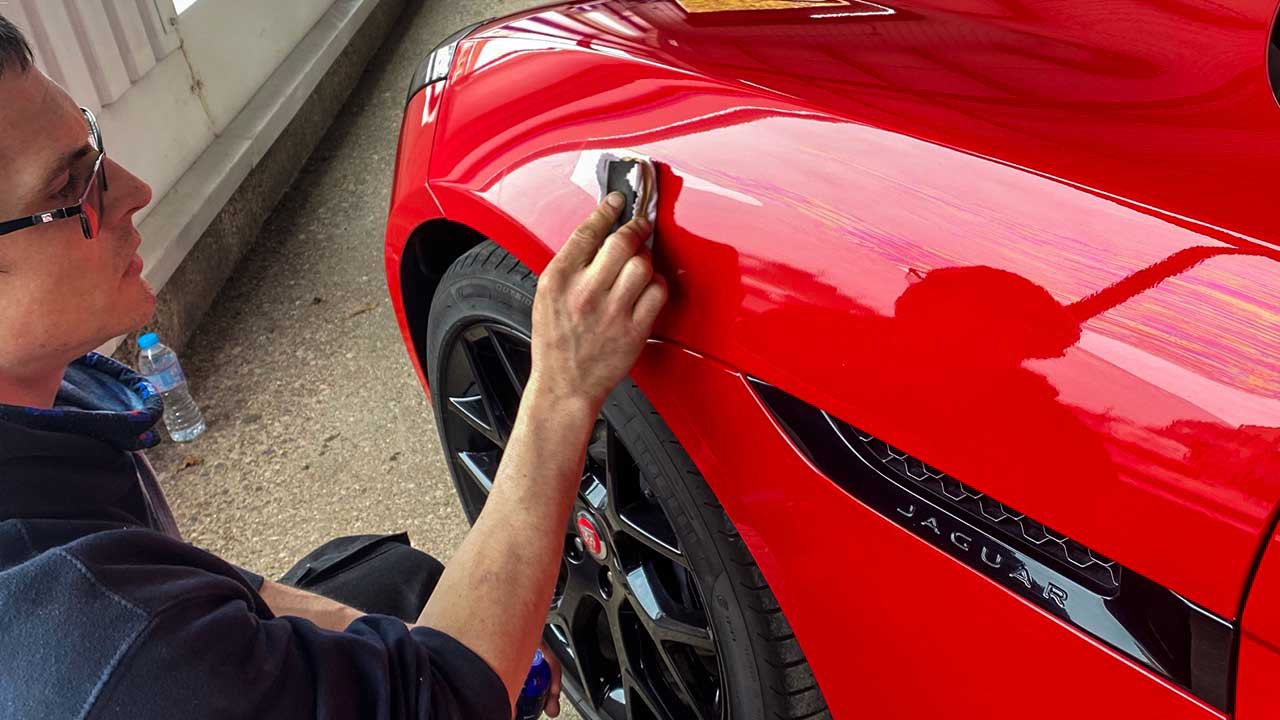
Professionally applying a ceramic coating is mostly about prep. We start with a thorough wash and decontamination to remove anything that would sit under the coating. Paint is then machine-polished to remove swirls and haze because coatings lock in whatever is beneath them. After a panel-wipe solvent leaves the surface clean, the coating is applied in small sections using a cross-hatch pattern.
As it flashes, we level the residue so you don’t get high spots or smears. Depending on the product, a second coat may be layered for coverage, and wheels, trim and glass may receive dedicated formulas. Curing needs stable temperature and time: keep the car dry for 12–24 hours, avoid washing for 5–7 days, and use gentle washes after that. The result is a slick, glossy finish with strong chemical resistance and easier cleaning. It isn’t a force field against stone chips or deep scratches, but it will keep good paint looking good for longer.
Why timing is critical
When an applied coating flashes off, it becomes dry, hazy much like a traditional wax or polish. And like a wax or polish, if you start to remove it before it's ready, you can end up smearing it around. This can be annoying with traditional products, but with ceramic and graphene coatings it can be disastrous as they are permanent coatings, more like a coat of varnish than a wax - disturbing them too soon could lead to a visible uneven finish. This is especially the case with the better quality thicker coatings, which can be unforgiving.
Conversely, as soon as the coating flashes off, it begins to cure. If left on too long, it becomes difficult to remove the hazy excess residue. This means there is a window of time in which you can operate. This window is greatly affected by temperature and humidity. On a hot dry day this window can be very short, while cold and damp can extend the window for hours and lead to uneven curing. Thus, it is essential the coating is applied inside, undercover in controlled conditions.
What this question is really about
When people ask how ceramic coatings are applied, they are usually trying to understand why the service takes time, why preparation matters so much, and why results can vary so widely between different installers.
Ceramic coatings are applied by hand, not sprayed on
Professional ceramic coatings are applied manually using applicators, working panel by panel. They are not sprayed like paint and they are not simply wiped on and left.
- Applied in controlled conditions
- Worked evenly across each panel
- Monitored closely during application
The surface must already be fully prepared
By the time the coating is applied, the car should already be clean, decontaminated, and corrected. The coating does not clean or improve the paint on its own.
- All dirt, fallout, and residues removed
- Any polishing completed beforehand
- The finish reflects the final result
Applying the coating
The coating is carefully applied in small sections to ensure even coverage and correct bonding.
- Applied using a suede or microfibre applicator
- Spread evenly across the panel
- Left to “flash” for a controlled time
What “flashing” means
Flashing is the point at which the solvents in the coating begin to evaporate and the coating starts to bond to the surface.
- Flash time varies by product and conditions
- Temperature and humidity affect timing
- Missing this window can cause high spots
Levelling and inspection
Once flashed, excess coating must be levelled off.
- High spots are gently removed
- Panels are checked under proper lighting
- This step prevents streaking and uneven finish
Layering (where applicable)
Some coatings allow multiple layers, applied after a set time.
- Each layer must cure before the next is applied
- More layers do not replace preparation
- Layering increases durability, not correction
The curing process
After application, the coating needs time to cure and harden.
- Initial curing takes several hours
- Full chemical cure develops over days
- Water and contamination should be avoided initially
Why correct application matters
- Poor application causes streaks and patchiness
- Incorrect timing reduces durability
- Shortcuts lock defects into the paint
Best-practice takeaway
- Ceramic coatings are applied carefully by hand
- Preparation is completed before application begins
- Flash timing and levelling are critical
- The coating protects the finish already created
What you should ask next
What are the main steps to applying a ceramic coating properly?
Wash, decontaminate, polish/refine if needed, panel wipe-down, careful coating application, then controlled curing. The prep is where most of the result comes from.
Do you have to polish before applying a ceramic coating?
Yes - because coatings don’t hide defects. Even on a new car, a light refinement can remove dealer marring and improve clarity before you lock the finish in.
How is the coating actually put on the paint?
It’s applied in small sections with an applicator, allowed to “flash”, then levelled/buffed off to avoid high spots. The exact timing depends on the product and conditions.
What are “high spots” and why do they happen?
High spots are areas where excess coating cures on the surface and leaves streaks or patches. They happen when the coating isn’t levelled properly, or timing/temperature/humidity isn’t controlled.
How long does it take to apply a ceramic coating?
The coating wipe-on/wipe-off part is only a slice of the job. Total time depends on how much correction is needed and how the coating needs to cure - it can be anything from a long day to several days. But you need to add to this cure time before the car can go out into the environment.
How soon can I drive or wash the car after coating?
You can often drive it fairly soon, but early exposure to rain and contaminants should be minimised. Washing should wait until the coating has cured properly, otherwise it can interfere with performance.
People also asked
Written by Danny Argent. Last updated 03/03/2026 15:07
Further Reading
-
Ceramic Coatings: The Definitive Guide
Ceramic coating is the latest and best thing, but it can cause confusion. In this guide, we answer questions and misconceptions about ceramic sealants. -
🍀 Self Cleaning Paintwork? - Ceramic Coating
You can see in this video how a little rain can wash away dirt and road grime when your car is coated with ceramic car paint protection.
Services
-
🔥🔥🔷 Ceramic Nano-Coating for Cars
Upgrade to ceramic coating for super-hydrophobic paint protection that keeps your car cleaner for longer, locking in showroom shine and making washing faster and easier. -
🔷 Fieball Dok Do
Fireball Dok Do 10-Year Dual Layer Coating-Formulated with incredibly high amounts of Si02 & Titanium Dioxide, this double layer coating guaranteed by our warranty to last a full decade.