
Moisture Meter
Quick answer: A moisture meter is a handheld instrument used to check how damp materials are inside a car, helping technicians see whether carpets, underlay, soundproofing and even the body shell are still wet after a leak, even when they feel dry on the surface.
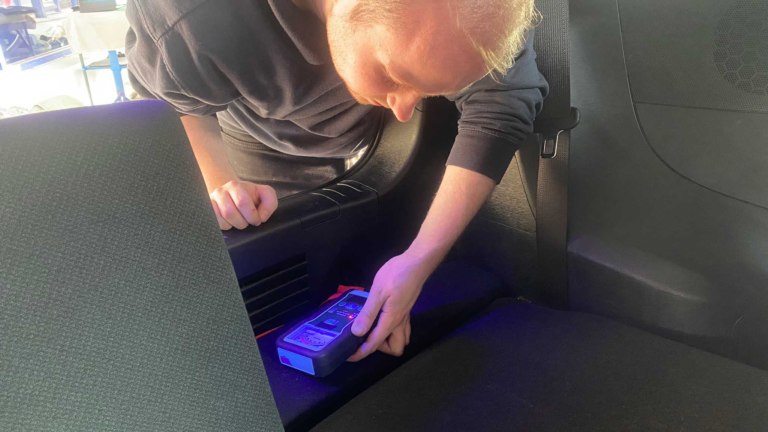
A moisture meter is an electrical device for measuring moisture levels in substances like wood or paper.
They are a useful tool in water leak detection because they allow us to quickly detect damp under carpets, without having to lift the carpets which, in a car, might involve removing the seats and other fittings.
Leaks can be very slow and take time to start causing issues. Once we have dried a car, we can take a reading to ensure it is dry, and then check again after testing by spraying the car with water. If the moisture levels go up significantly, we know we still have a leak.
What it means
A moisture meter is a diagnostic tool for spotting damp. It usually has either two small pins that touch the material or a flat sensing pad that sits on the surface. When placed on carpets, underlay, soundproofing or body panels it gives a reading that indicates how much moisture is present compared with a known dry area. Rather than guessing by hand feel, the technician can see where materials are still wet, where they are drying and where they are genuinely dry.
Why it matters
- Reveals hidden damp: Thick foams and underlay can stay wet long after the carpet surface feels dry. A moisture meter shows what is happening deeper down.
- Maps the spread of a leak: By taking readings at several points, a technician can see how far water has travelled along the floorpan, into cross members, up pillars or into the boot area.
- Checks drying progress: During professional drying, repeat readings show whether moisture levels are falling to normal, helping decide when the car is ready to reassemble.
- Supports honest reporting: Meter readings provide evidence for reports and estimates, showing that damp is present even when it cannot be seen, or confirming that areas are now dry.
Where you’ll see it
You will see moisture meter or damp meter mentioned in leak reports, water damage assessments and drying documentation. Typical comments include moisture meter shows elevated readings in rear footwells, moisture readings now normal after drying, high moisture detected under driver’s seat or readings indicate water has tracked into rear cross member. It may also appear in structural and corrosion checks where hidden cavities are being assessed.
Context
A moisture meter is one of several tools used in a proper leak and water damage process. It works alongside lifting carpets, smoke and bubble testing, checking drainage pipes, rear vents, membranes and scuttle areas. The usual sequence is to find and fix the leak, lift carpets and underlay, then use the meter to identify all damp areas before deciding what needs drying, decontamination or replacement. During drying, periodic readings confirm progress so the car is not reassembled over materials that are still wet. Because most meters give relative rather than absolute readings, the operator will usually compare suspected wet areas with known dry reference points on the same car.
Common mistakes
- Assuming that normal-feeling carpet on top means the foam and underlay beneath are dry, without checking with a moisture meter.
- Taking a single reading in one spot and declaring the car dry, instead of comparing several locations and using known dry areas as a reference.
- Misreading the meter scale and treating relative readings as precise percentage moisture content.
- Ignoring high readings in hidden areas because they are awkward to access, then finding mould, smells and corrosion returning later.
Written by Danny Argent. Last updated 08/12/2025 17:12