Polishing Bonnet

Quick answer: A polishing bonnet is a cloth disc with an elasticated rim that slips over the backing plate of a polisher to spread or buff polish and wax. They are largely a retail and old-school tool now; professional paint correction uses foam, wool and microfibre cutting pads on dual-action or rotary machines instead. (The word "bonnet" also means the hinged front panel of a car -- the part Americans call the "hood".)
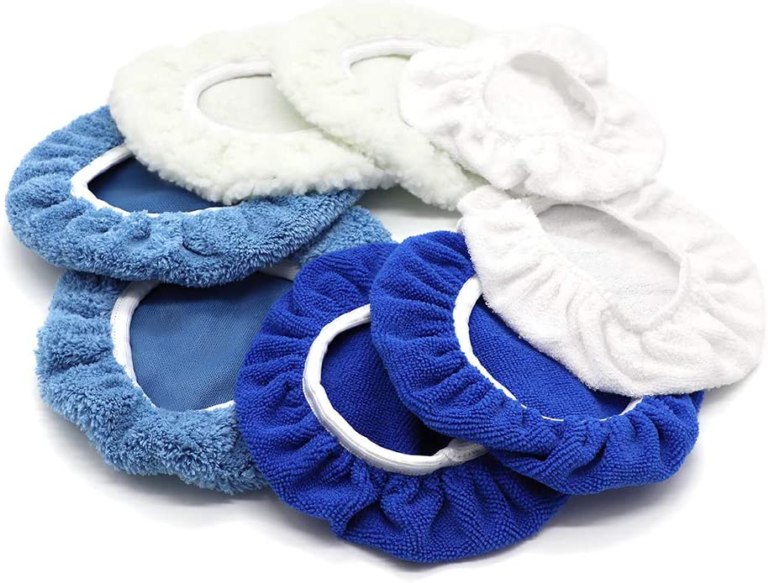
"Polishing bonnet" trips a lot of people up because the word does double duty. Most people who land here mean one of two things: the soft cloth disc that fits over a polisher, or polishing the actual bonnet of a car -- the big front panel. We will take the tool first, because that is what "polishing bonnet" specifically names, then deal with polishing the panel, because in practice that is the job most people want done.
The tool: what a polishing bonnet actually is
A polishing bonnet is a disc of cloth with an elasticated band sewn round the edge. You stretch it over the foot or backing plate of a machine polisher, and the cloth face does the work against the paint. Historically they came in a few materials, each for a different stage: a fine muslin or terry weave for laying polish or wax on, a softer towelling for wiping it off, and lambswool for the actual cutting and burnishing.
They belong to an older way of polishing. You still find them bundled with budget retail polishers -- the orbital "car buffers" sold in motor factors and online -- usually in a more modern microfibre or synthetic-lambswool material rather than the old cotton. For a once-a-year wax on a tidy car they are fine. What they are not is a paint-correction tool, and that is where the confusion does real damage.
Why we don't use them for correction
Proper machine polishing -- removing swirls, etching and light scratches rather than just smearing a glaze about -- depends on controlling exactly how much abrasion happens and where. That control comes from matched pads and pad backing: a firm foam cutting pad behaves very differently from a soft finishing pad, and a wool pad different again. A loose cloth bonnet stretched over a plate gives you almost none of that control. It flexes, it grabs unevenly, and on a dual-action machine it kills the very oscillation that keeps the process safe.
There is also a heat problem. Cloth bonnets, lambswool especially, hold product and friction in a way that builds heat fast on a high spot or a panel edge. On a modern thin clearcoat that is exactly how you strike through to primer -- a burn-through that no amount of polishing fixes and that means a respray. Tom, our operations manager, has lost count of the "I had a go with the kit that came with the polisher" cars that come in with a dull witness mark on a bonnet edge or a wing crown where a bonnet has snatched and overheated one spot.
Polishing the panel: why the bonnet gets singled out
The other reading -- polishing a car's bonnet -- is the job we actually do, and the front panel earns its own attention for good reasons. It is large, near-flat and horizontal, so it catches light and shows every swirl, hologram and water spot more clearly than any vertical panel. It is also the panel the owner looks at most and the one a buyer or a lease inspector clocks first.
It is the hardest-worked panel too. Stone chips, bird lime, tar, tree sap and bonded fallout all land heaviest on the bonnet because it faces the road and the sky at once. By the time a car comes to us for correction, the bonnet is usually a full stage worse than the doors. So when a price list says "bonnet machine polish" as a line on its own, that is not padding -- it reflects genuinely more work.
How the panel is actually corrected
The honest version of the process, so you can judge whether it is a job for a Saturday afternoon. First the panel is washed, then clayed or used with a clay mitt to pull bonded contamination out of the clearcoat -- skip this and you drag grit across the paint with the pad. Then we take paint-depth readings with a gauge; a bonnet that has been touched-in or partially resprayed can have wildly uneven film build, and you need to know that before you cut.
Correction itself is staged: a cutting compound on an appropriate pad to remove the defect layer, then one or more refining steps to bring back gloss and clear the haze the cut leaves behind. Each stage gets wiped down and inspected under proper lighting -- swirls hide in daylight and only show under a hard single-point source. Get the pad, product, speed and pressure wrong on any stage and you either do nothing or you do too much. There is no cloth-bonnet shortcut through that sequence.
Common mistakes
- Treating a cloth bonnet as a correction tool. It spreads product; it does not reliably remove defects, and it removes your control over heat and abrasion.
- Running a lambswool bonnet hard over a panel edge or a swage line, where the clearcoat is thinnest -- the classic strike-through.
- Skipping the decontamination and paint-depth steps and going straight in with a machine, so grit gets ground in or thin paint gets cut too far.
- Confusing the tool with the soft-top "hood" of a convertible, or assuming "bonnet" and "hood" are different parts when they are just UK and US words for the same front panel.