Can a ceramic coating protect a car from bird droppings?

Quick answer: A ceramic coating won't make a car bird-proof, but it does buy you time. The coating takes the acid attack instead of the paint and slows the etching, so droppings are far less likely to leave a permanent mark -- provided you get them off reasonably promptly and don't let mess bake on a hot panel for days. Fresh bird mess left for hours on a sun-hot bonnet can still etch through the coating to the paint, so urgency of removal still matters.
It is one of the most common questions we get from customers who have just paid for paint protection, and the honest answer is reassuring without being absolute. A ceramic or graphene coating gives bird droppings a much harder time, but it is a sacrificial barrier, not a force field. Understanding why it helps -- and why it isn't a free pass to leave mess on the car for a week -- is the difference between a coating that still looks immaculate after two years and one that has a faint constellation of etch marks across the bonnet.
Why bird droppings attack paint in the first place
Depending on what the bird has been eating, droppings can be surprisingly corrosive. They carry uric acid at a very low pH, and on a bird with a fruit-and-berry diet that acidity is higher still. On unprotected paint the acid reacts directly with the clear coat, eating into the surface and leaving a dull, frosted ring once the mess is removed. In the worst cases the etch goes deep enough that it can only be polished out, and if it has reached the colour coat it may not come out at all.
Heat is the accelerant. A bonnet or roof sitting in summer sun can climb well past 50°C, and the chemical reaction roughly doubles in speed for every ten degrees. That is why a dropping that would take a couple of days to mark cool paint can etch a hot panel in a matter of hours. The mess also dries faster on a hot surface, which makes it harder to lift cleanly later. If you find dried-on bird poop stuck to the paint, do not be tempted to soften it with hot water -- you will simply speed the reaction along.
There is a second factor people forget: texture. A dropping is rarely smooth. It carries grit, seed husks and tiny fragments of shell, and once it has dried hard it behaves like a small lump of sandpaper bonded to the panel. So you are not only fighting an acid; you are dealing with an abrasive that will mar the surface the instant you wipe at it carelessly. That matters enormously for how you remove it, coated or not.
What the coating actually does
A cured ceramic or graphene coating sits on top of the clear coat as a hard, chemically resistant layer. When acid lands on it, the coating reacts first; the uric acid attacks the sacrificial surface rather than the paint underneath, and the reaction is slowed considerably by the coating's density and its resistance to chemical penetration. The slick, low-energy surface also stops the dropping bonding as aggressively, so it tends to lift more easily when you come to clean it.
What a coating does not do is stop the attack altogether. Given enough time and enough heat, acid will work through any sacrificial layer and reach the paint. We have seen coated cars come in with light etching, and almost every time the story is the same: the mess sat there for a fortnight, or the car lived under a tree and got hit repeatedly on the same spot, or it was parked nose-to-the-sun all week with droppings baking on the bonnet. The coating bought time; nobody used it.
A mark on a coated car nearly always has a reason
When a customer brings us a coated car that has marked, the cause usually falls into one of three buckets, and it is worth knowing them because all three are avoidable:
- Time: the droppings were left far too long. A coating slows the clock, it does not stop it.
- Heat: the panel was hot for an extended period, which can multiply the reaction speed several times over.
- Contamination under the dropping: there was bonded contamination already sitting on the surface that should have been lifted during decontamination before the coating went on, leaving a weak point.
That last one is why preparation matters so much. A coating applied over a properly decontaminated, corrected panel is a continuous, even barrier. A coating laid over contamination is a barrier with holes in it, and acid finds the holes. The coating's job is to slow the attack; yours is to spot the mess and get it off before the clock runs out.
How quickly does it actually need to come off?
Customers want a number, and we understand why, but the honest answer is that it depends on the weather and the bird. As a rule of thumb we tell people this: on a coated car parked in the shade or in cool weather, a dropping you remove within a day or two will almost never leave a mark. The same dropping on a coated bonnet sitting in direct July sun is a different proposition entirely; on a panel that hot, you are working in hours, not days, and we would not want it left overnight. The point of the coating is not that you can ignore the mess for a week; it is that you have a comfortable margin instead of a frantic one, and that occasional slip -- the dropping you missed on the way out, found when you got home -- is far less likely to cost you a polishing session.
If you only remember one thing, make it this: hot panel plus fresh mess equals act now. Everything else can wait until you are home.
Removing bird mess from a coated car without marking it
The temptation is to grab whatever cloth is nearest and rub. On a coated car this is the single most common way people put swirl marks into a finish that was supposed to be protecting them from exactly that. Because a dried dropping is abrasive, the safe sequence is built entirely around lifting and floating the mess off, never dragging it. Here is the order we use in the workshop and the order we recommend to customers:
- Soak first, touch second. Spray the dropping generously with a bird-mess or bug remover, or just water, and let it dwell for a minute or two. The goal is to rehydrate and soften the crust before anything touches the paint.
- Lift, don't wipe. Lay a soaked microfibre or a wet wipe over the area, let it sit a moment longer, then gently lift it away taking the bulk of the mess with it. If anything resists, re-soak rather than scrub.
- Flush the residue. Spray and wipe the area once more with a clean side of the cloth to clear the softened remnants, working in one direction rather than back and forth.
- Neutralise. At the first proper wash, go over the spot with a pH-neutral shampoo; a spoon of baking soda in the soapy water is a sound belt-and-braces step because it is mildly alkaline and neutralises any acidic trace left behind.
What to avoid is just as important as what to do. Never use a dry cloth on a dry dropping; never use hot water to speed things up, because heat drives the acid reaction; and never reuse the contaminated cloth on the rest of the car, because you will simply move grit around. If a dropping has set rock-hard and will not soften, keep re-wetting it and give it time rather than reaching for an abrasive; patience costs you ten minutes, a scratch costs you a polish.
What to keep in the car
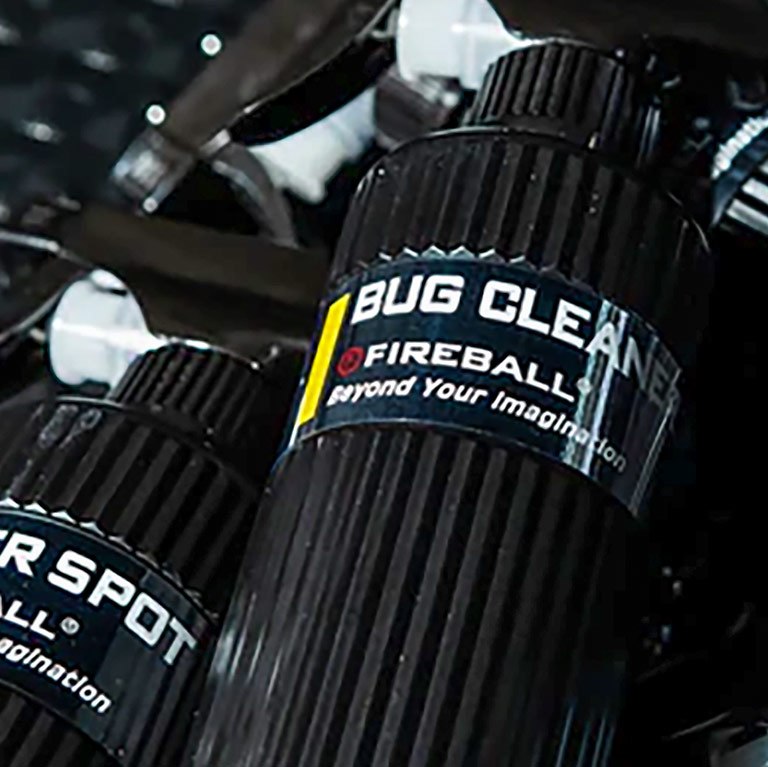
The single most useful habit is keeping a small kit in the boot so you can act the moment you spot a dropping rather than waiting until you are home. Tom, our operations manager, keeps a bottle of Fireball Bug Cleaner and a soft microfibre in his own car for exactly this, and a pack of baby wipes lives in the door pocket as the grab-it-now option. The wipes are not the perfect tool, but a baby wipe used straight away beats a perfect product used three days later, and that trade-off is the whole point. A bug remover doubles up neatly here: the chemistry that softens splattered insects works just as well on droppings, so you do not need a shelf of single-purpose bottles.
So the coating is genuinely worth having for this. It turns a problem that could ruin a panel in an afternoon into one you can usually shrug off, as long as you do your half of the job. The coating slows the clock; the kit in your boot and the habit of acting quickly are what actually keep the paint clean. For the broader picture on what paint protection buys you, see What are the benefits of a ceramic coating?.