How thick is car paint?

Quick answer: Most factory paintwork totals about 80-140 microns (0.08-0.14 mm) across primer, base coat and clear coat: roughly the thickness of a human hair. The clear coat alone is typically ~30-50 µm, and that thin layer is the only part a polisher actually works on. Edges and sharp body lines read thinner; repainted panels are usually thicker, often 180-300+ µm.
It surprises people how little there is. The entire painted finish on a modern car (primer, colour and clear) is usually somewhere between 100 and 180 microns, and the part that gives you gloss and protects the colour is a clear coat barely 30 to 50 microns deep. A micron is a thousandth of a millimetre, so the whole system is about as thick as a single hair laid flat on the panel. Once you understand that, a lot of the caution around polishing, machine correction and "cutting back" paint starts to make sense.
The layers, from steel to shine
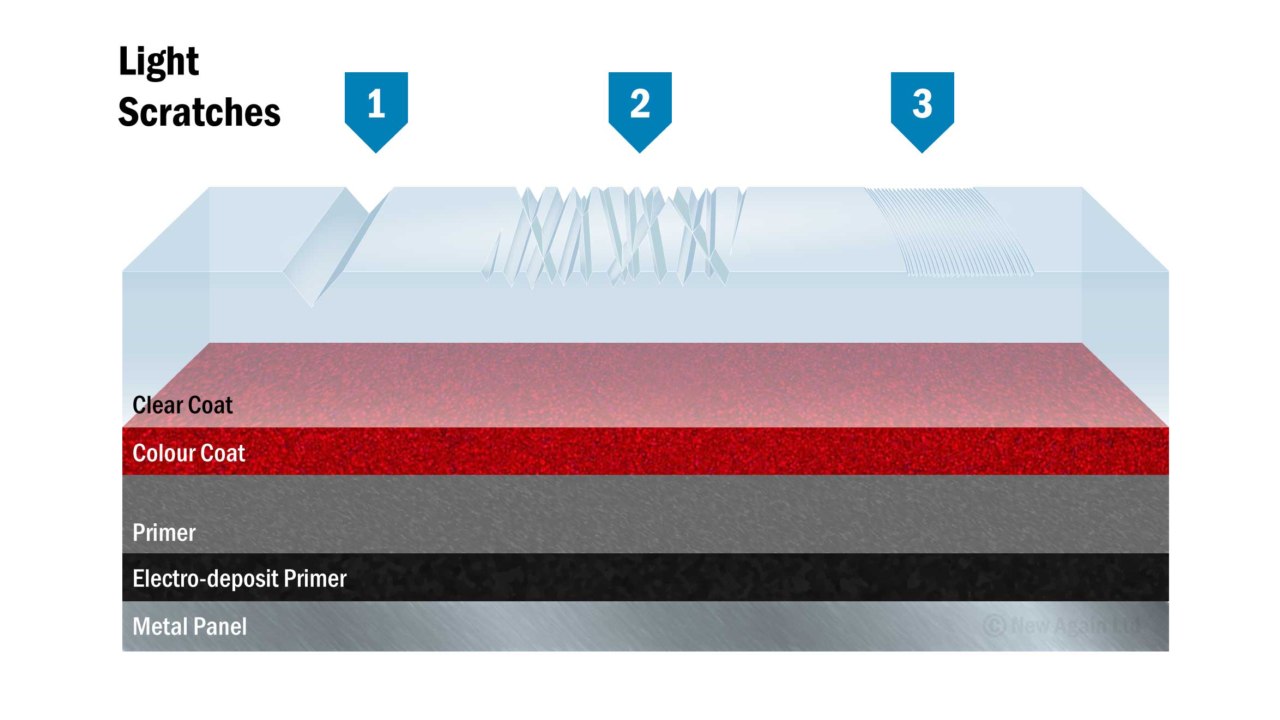
A standard clear-over-base finish is built up in stages, each doing a different job:
- Primer (~20-40 microns): bonds to the panel, fills minor imperfections and gives the colour something to key to.
- Base coat (~10-30 microns): this is the colour, and on metallics and pearls it carries the flake or mica. It has almost no gloss of its own.
- Clear coat (~30-50 microns): the hard, transparent top layer that produces the shine and takes the UV, the wash marks and the day-to-day abrasion.
Add those together and the colour-plus-clear part you can see is only around 40 to 80 microns sitting on top of the primer. That is the working envelope. Everything a detailer does with a machine happens inside the clear coat layer alone; and there is not much of it.
It varies by manufacturer, model and even by panel. Bonnets and roofs sometimes run a touch thinner because they are large flat surfaces sprayed in fewer passes; plastic bumpers are often painted more lightly than the steel they sit beside, which is why a bumper can colour-fade ahead of the wing next to it. Luxury cars can sit higher up the range (some German marques layer the clear quite generously) while budget models tend to sit at the lower end.
How we actually know what is under the lacquer
We measure paint with an electronic paint depth gauge: a small probe that reads the total film thickness in microns by sensing the distance to the metal underneath. On a car we are about to correct, Tom, our operations manager, will take readings across every panel before anything touches the paint: roof, bonnet, both wings, the doors, the boot lid. It takes a couple of minutes and it tells us how much "room" there is to work with.
Here is the honest part, though: on a healthy factory finish the gauge is mostly a safety check. Machine polishing removes only a few microns of clear coat across an entire correction (often less than five) so on paint reading 120 microns there is plenty of headroom. We really only lean on the numbers when we are doing serious paintwork correction on deeper scratches, or when a reading looks odd and we want to know why before we commit a pad to it.
That "why" matters. A gauge gives you one number (total film thickness) and it cannot tell you what is making up that number. A panel reading 250 microns might be a thick, sound respray. It might equally be a thin coat of paint sitting over a slug of filler from an old repair. The reading is identical; the way you treat it is not.
The panel that read 600 microns
A few years back we had an estate car in for a one-stage enhancement (nothing dramatic, just a tidy-up before sale). Most of it read a sensible 110 to 130 microns. The nearside rear quarter came back at over 600. No paint system on earth is built that deep; that is body filler doing the talking. Sure enough, tapping it gave the dull, dead sound of filler under paint rather than the ring of steel. We backed right off that panel, kept the machine speed and pad pressure low, and treated the lacquer over it as a complete unknown. Polish filler-backed paint the way you would polish factory clear and you can generate heat the repair cannot shed, which lifts the lacquer or burns through it. The gauge did not tell us the panel had been repaired, but it told us to slow down and find out, which is exactly what it is for.
Older paint: single-stage finishes
Before clear coat systems became standard, cars were finished in single-stage paint: colour and gloss combined in one layer over a primer. The overall build was not miles off today's, usually 80 to 140 microns in total: around 20 to 40 microns of primer with 40 to 100 microns of colour on top. The difference is that the gloss and the colour are the same layer, so when you polish single-stage paint you are abrading pigment directly. A clean microfibre often comes away tinted with the car's colour: a sight you never get on a clear-coated car, and a useful reminder that there is no sacrificial top layer to protect the colour underneath.
Consistency was not really the name of the game back then. Coachbuilt cars and hand-sprayed finishes often got more coats, then were flatted back and polished. Some panels ended up thin, others much thicker. On high-end cars, or where a painter laid it on heavy, readings of 150 to 300 microns or more were not unusual. By the '70s and '80s solid colours were still mostly single-stage, while metallics and pearls pushed manufacturers toward clear coat systems, because flake simply looks better sealed under lacquer than exposed at the surface.
The takeaway: old paint can be all over the place. If you are checking a classic with a paint depth gauge, do not be surprised when the numbers jump panel to panel. Really high readings usually mean it has been refinished somewhere along the line. Most classics we see now have been repainted by hand at some point, and they often carry a nice thick coat of hard-wearing 2-pack paint, which gives more to work with than the original ever did.
Why a few microns decides everything
If the whole clear coat is 30 to 50 microns and a heavy correction might take five, you can see there is no infinite supply. Each genuine correction step removes a little, and clear coat does not grow back. A panel can usually take a careful machine polish several times over its life, but every aggressive cut spends some of that budget, which is why we always reach for the lightest pad and compound that will do the job rather than the fastest.
Three places need extra respect. Edges, swage lines and the peaks of body curves always read thinner than the flats around them, because paint flows away from a sharp edge as it is sprayed and cures. They are where almost every burn-through happens, so we either keep the machine off them entirely or work them by hand with the gentlest combination we have. Repainted panels add their own complication: a high reading might be a thick clear coat, or it might be filler and extra primer that behave nothing like factory paint under heat. Knowing the difference is most of the skill.
None of this should put a careful owner off looking after their paint. A wax or a light hand polish removes effectively nothing, and a single well-judged machine correction on healthy paint is entirely within budget. The trouble starts with repeated heavy cutting, cheap aggressive compounds and a rotary in unpractised hands on a thin edge, the kind of damage a gauge would have warned about a minute earlier. That is the real reason we measure first: not because the numbers are usually alarming, but because the one time they are, you are very glad you looked.