What are wash marks?

Quick answer: Wash marks are fine scratches in the clear coat -- the circular "swirls" you see in sunlight -- caused by grit dragged across the paint during washing or drying. Light ones will machine polish out. Deeper damage is paintwork correction territory. Prevention is a safe wash routine and a clean microfibre drying cloth.
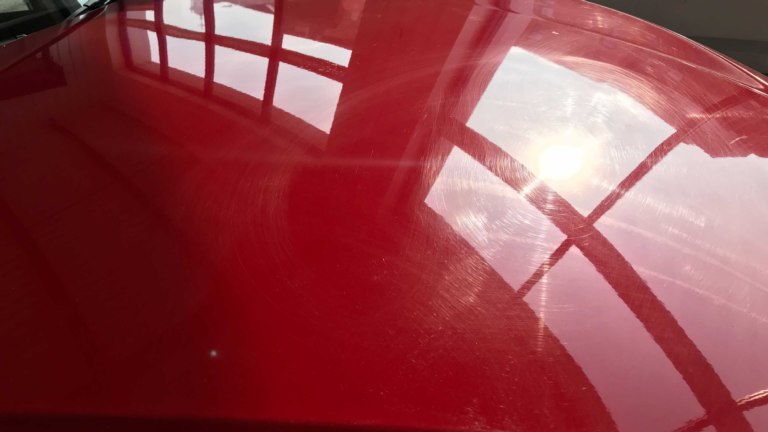
Wash marks are the fine scratches a car picks up from the simple act of being cleaned. They sit in the clear coat, the hard lacquer layer over the colour, and they catch the light as faint circles and arcs. Look at almost any car on a sunny day and you will find them. They are close to impossible to avoid entirely, but the worst of them -- the deep, swirling halo people notice across a bonnet -- comes down to how a car is washed, and that is something you can control.
Why paint picks up wash marks so easily
Paintwork is softer than most people assume; certainly softer than the road grit, brake dust and baked-on grime sitting on a dirty panel. That is the whole problem. Shifting dirt off the surface without letting any of it drag across the lacquer is genuinely difficult, even with techniques built specifically to reduce micro-marring. Every wash is, in effect, a controlled abrasion. The job is not to avoid touching the paint -- you have to -- but to make every point of contact as clean and gentle as possible, and to stop loose grit being pressed into the surface like sandpaper.
This is why two cars of the same age and colour can look so different. The one that has been pre-rinsed, washed with clean water and dried on a soft towel keeps a sharp, mirror-like finish. The one that has been wiped over with whatever cloth was to hand develops a dull, cobwebbed haze that you only really see once the sun is on it.
Car washes, jet washes and hand washing compared
Most drivers no longer wash their own car; they run it through a machine. The old roller-and-brush units were the worst offenders, dragging stiff bristles loaded with the last fifty cars' grit straight across the paint. The newer soft-cloth and touchless machines are a real improvement, and a touchless wash that relies on chemistry and high-pressure water rather than physical contact is the gentlest of the automated options. Even so, anything that touches the paint adds fine scratches that build up over time and eventually read as swirl marks under harsh light.
A careful hand wash beats all of them, but only when it is genuinely careful. The good news is that if a car has only ever been washed gently, those scratches tend to be shallow and will polish out. It is the cumulative effect of poor technique over years that turns a faint haze into the deep, hologram-like pattern that brings people to us.
Where the serious damage really comes from
The worst wash marks we see are not from the owner at all; they are from bad practice on someone else's part. If somebody in a fluorescent bib with a bucket on a trolley approaches you in a supermarket car park and offers to clean your car, politely tell them to stroll on. These outfits will happily wash five cars from the same bucket of water, use a sponge that keeps hitting the floor, and skip the pre-rinse that removes the coarse grit. Vigorous sponging on top of that grinds dirt into the lacquer with every stroke.
Some of the cheaper valet operations cause a different kind of harm: detergents strong enough to etch and burn paintwork, plastics and rubber trims. That damage counts as a wash mark too, and it is usually a job for paintwork correction rather than a quick polish. Matt, who does a lot of our correction work, will tell you the giveaway is a car that comes in covered in tight, identical swirls all running the same way -- that is a machine or a single dirty mitt, not the owner's careful Sunday wash.
How to spot wash marks on your paint
You do not need a paint depth gauge for a first look; you need good light. Stand back from the car in bright, direct sunlight, or play a strong torch or phone light across a panel in a dark garage. Look for faint circular or spider-web patterns radiating from a central point. Darker colours -- black, navy, deep red -- show them most clearly, which is why owners of dark cars tend to notice the problem first. Lighter silvers and whites hide a surprising amount.
Run a fingertip gently over the area as well. Light wash marks feel perfectly smooth; the damage is too shallow to catch a nail. If a scratch does catch your nail it is deeper than a wash mark and may not polish out fully. One useful tell: long horizontal swipes across the top of a bonnet or boot usually point to careless drying rather than the wash itself, because that is the direction a towel travels when someone wipes a panel down in a hurry.
A safe wash routine that prevents them
Prevention is mostly about sequence and clean kit. The core of a safe wash is short:
- Pre-rinse the whole car thoroughly to flush off loose grit before anything touches the paint.
- Use two buckets -- one for shampoo, one to rinse the mitt -- with grit guards in the base of each.
- Swap any sponge for a clean lambswool or microfibre mitt, and rinse it often.
- Wash the top panels first and work down, leaving the dirty lower sills and bumpers until last.
After that, dry with a clean, plush microfibre drying towel rather than a chamois that has been sitting on the garage floor. Keep a separate mitt and towel just for the wheels and never let them near the bodywork: brake dust is the hardest, sharpest contaminant on the car, and a wheel mitt is carrying it. Washing in the shade rather than direct sun matters too, because shampoo that dries on a hot panel before you can rinse it tempts you into scrubbing harder.
Can wash marks be polished out?
In most cases, yes. Shallow wash marks sit in the top few microns of the clear coat and respond well to machine polishing with a mild polishing compound. The machine works a tiny amount of lacquer off the surface so that it sits level with the bottom of the scratches, and the haze simply disappears. Our page on paintwork correction explains the levels: a single-stage enhancement for light marring, multi-stage correction where the scratches run deeper.
There is a limit, though. The clear coat is only so thick, and once a scratch has cut through it into the colour beneath, polishing cannot bring it back -- there is nothing left to level into. That point is a respray, not a correction. It is also why repeated heavy machining is not free: each correction removes a little lacquer, so the aim is always to fix the marks once and then protect the finish so it does not happen again.
Common mistakes that make wash marks worse
A few habits do most of the damage. Dry-dusting a dirty car with a cloth to tidy it up before an appointment grinds grit straight across the paint; it is one of the quickest ways to ruin an otherwise clean finish. Using the same sponge week after week without rinsing the trapped grit out of it does the same harm, just more slowly. A household bath towel is far too coarse for paintwork: the hard loops snag and scratch where a proper drying towel glides. Washing in full sun bakes the shampoo on and pushes you into scrubbing. And relying on a cut-price supermarket valet between proper details is the fastest route back to a swirl-marked bonnet, however good the car looked when it left.
None of this means you should be afraid to wash your car. Quite the opposite: a sensible routine with clean kit keeps the paint in far better condition than leaving it dirty and hoping for the best. The mistakes are easy to avoid once you know what causes them, and the payoff is a finish that still throws back a clean reflection years down the line.