Can you repair soft top roofs?

Quick answer: Yes -- but only the right kind of repair. We handle minor cosmetic work: small holes patched from behind where access allows and blended with loose fibres, perished rubbers and lifting trim tidied up, and we specialise in finding and fixing leaks. The result is durable but not invisible. For mechanism faults, electrical problems, or a roof bad enough to need a replacement kit, you want a dedicated folding-roof specialist instead.
"Can it be repaired?" is really two questions wearing one coat. There's the cosmetic kind of damage -- a stone chip through the fabric, a perished seal, trim that's started to lift -- and there's the structural kind, where the weave itself has failed or a seam has let go. We're good at the first sort and honest about the second, and most of this article is about telling them apart before you spend money on the wrong fix.
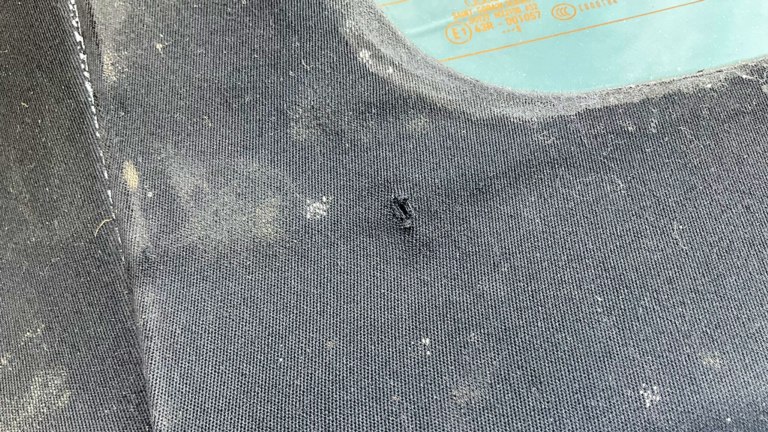
Where the fabric came from changes everything
Before anyone reaches for a patch, it helps to know what you're patching. A soft-top is one of three broad materials, and each behaves differently when it's damaged. Vinyl is a coated fabric with a smooth face; it takes a rear-access patch well because the surface is uniform and there's no pile to disguise. Mohair -- the premium woven cloth fitted to a lot of German and British convertibles -- looks superb but is far harder to blend, because the raised pile catches light and shows up any change in direction or density. A standard fabric hood sits somewhere between the two.
None of this is about whether we'll attempt the repair; it's about setting your expectations honestly before we start. On vinyl, a small repair near the back of the roof can be genuinely hard to spot. On mohair, the same repair will be sound and weatherproof, but you'll know where it is in certain light. That's not a failing of the technique -- it's just the pile telling the truth.
How a small hole actually gets fixed
The honest version of a cosmetic tear repair is less glamorous than people imagine, and worth spelling out because it explains why size matters so much. First we have to get behind the damage. On many roofs the headlining or an interior panel blocks the back of the fabric entirely, so step one is gaining access, and sometimes that access simply isn't there without dismantling more of the car than the repair is worth.
Where we can get behind it, we glue a backing patch to the rear of the fabric so the hole can't spread, then fill the gap from the front with loose fibres teased and blended to match the surrounding weave. It's the same principle we use for carpet repairs -- mechanically stable, hard-wearing, and stable in rain once it's cured. What it isn't is invisible. Close up you'll still find the spot; from a couple of feet away it disappears into the pattern. Anyone who promises a flawless, undetectable mend on a fabric roof is either very lucky or not being straight with you.
This is the whole reason size is the deciding factor. A stone chip or a cigarette-burn-sized hole has enough surrounding weave to borrow fibres from and blend into. A longer rip doesn't; there's too much area to fill and nowhere convincing to hide the join, so a cosmetic patch on a big tear just looks like a cosmetic patch on a big tear.
Rubbers, trim and the roof that only looks finished
A surprising number of "the roof's had it" jobs turn out to be nothing of the sort. Perished rubbers and lifting trim do far more than their share of making a hood look tired and tatty, and both are straightforward for us to sort. Tom, our operations manager, will often look at a roof a customer has already half-written-off and find the fabric itself is fine -- it's the seals that have hardened, shrunk and pulled the edges out of line. Sort those and the same roof reads as ten years younger.
The seals matter for more than looks. Perished rubber is one of the most common routes for water to get in, which is why weather-proofing and leak work so often go hand in hand with trim. A roof can be in perfectly good fabric condition and still leak like a sieve because a single length of seal has gone hard.
Leaks are our actual speciality
This is where convertibles overlap with the rest of what we do. We run full leak finding and fixing on soft-tops, and a leaking hood is rarely leaking where the owner thinks. Water tracks. It enters at a tired seal or a blocked drain channel, runs along the inside of the frame, and emerges as a damp footwell or a wet rear seat a long way from the real entry point. Chasing the wet patch rather than the source is how people end up sealing the wrong thing three times over.
Convertibles have a particular trap built in: the drainage. The folding roof sits in a well, and that well has drain tubes that carry rainwater away. Block one with leaf litter or grit -- and over a few autumns they always silt up -- and the water has nowhere to go but into the car. We've traced more than one "torn roof" leak to a drain tube the size of a drinking straw, fully clogged, with the fabric itself completely sound. Once a leak is traced and resolved we'll weather-proof the fabric to finish the job properly.
The jobs we send elsewhere, and why
Two categories sit firmly outside what we take on, and it's worth being clear about both.
The first is the roof mechanism and its electrics. When a powered roof won't fold, sticks halfway, or throws up a fault, that's hydraulics, sensors, motors and control modules -- a different trade entirely from fabric and finish. For that, and for a full replacement roof kit, we point people at a company that specialises in folding-roof systems, such as Cayman Autos. There's no point us pretending otherwise.
The second is serious fabric damage: long rips, seams coming apart, a rear window separating from the cloth. These are rarely economic to repair, and the reason comes down to what the repair genuinely involves. An upholstery trimmer is not a seamstress, as they like to remind us with some colourful language -- one of ours, asked once too often whether he could just hand-sew a roof in place, shot back "Right? Want me to darn your f#$%ing socks for you too?" -- and they will not stitch a roof while it's still on the car.
Done properly, mending a major tear means removing the entire roof, cutting out the damaged panel, sourcing matching fabric if it's even still made, sewing the new panel in, and refitting the lot. By the time you've paid for that labour you're within touching distance of a brand-new roof kit anyway -- which is exactly why, past a certain point, "repair" and "replace" become the same conversation, and the sensible money goes on replacing.
So, can a soft top be repaired?
Yes, with a clear conscience, for the things that genuinely respond to repair: small holes where we can reach the back, perished seals, lifting trim, and leaks traced to their real source. Those are durable, sensible fixes that buy a good roof years more life. For mechanism and electrical faults, or for fabric damage past the point of blending, the honest answer is that a folding-roof specialist or a new kit is the better spend -- and we'd rather tell you that up front than take money for a repair that was never going to last.