What convertible roof cleaner do you use?

Quick answer: We use a bulk trade detergent concentrate, diluted to suit the job. For cabriolet hoods we mix it slightly stronger -- but not so strong that it harms rubbers or trim -- and we don't publish the brand because it's only sold in bulk. For DIY, Renovo Fabric Soft Top Cleaner is the product we'd point you to first. For specific contamination like tree sap, reach for a dedicated tar and bug remover before the hood cleaner; general detergent alone won't always shift aged resin. The real "secret" is agitation: mechanical brushes and elbow grease.
There is no magic bottle of convertible roof cleaner that separates the pros from the amateurs. We buy a general-purpose trade detergent in 25-litre drums and dilute it to the job. What makes it work on a cabriolet hood is the dilution rate and the agitation, not a secret formula.
The detergent we actually use
We buy a concentrated detergent in 25-litre drums and dilute it down to the strength a given job needs. We won't name the brand, and not for any cloak-and-dagger reason: it is a trade product sold in bulk only, the supplier doesn't deal with retail customers, and naming it would just send people chasing a drum they can't buy and wouldn't want stored in a domestic garage. If you do work out what it is, please don't ring them.
It is a general-purpose detergent. The only trick is that we mix it slightly stronger for soft tops than we would for seats or carpets. Cabriolet hoods are made from a tougher synthetic fabric and take a stronger soap, but not so strong that it attacks the rubbers and trim around the roof line.
That trim point matters more than people expect. The fabric will tolerate a hot mix; the seals, beading and painted surrounds beside it will not. Get the dilution wrong and you don't damage the hood -- you bleach a window seal or leave a tide-mark on a sill. So the dilution we settle on is always a compromise between "strong enough to lift the grime out of the weave" and "mild enough to be safe on everything the run-off touches on its way down."
Stronger than the shelf, milder than the car wash
Our working mix sits in an odd middle ground. It is a little hotter than the retail soft-top cleaners on the shelf at a motor-accessory store -- which are deliberately gentle, because they're sold to people who might not rinse properly. But it is almost certainly milder than the pre-wash a typical roadside hand car wash slings over your paint and roof.
Those crews are known for brewing a Cillit-Bang-strength Traffic Film Remover that can etch plastic and bleach carpets. It shifts dirt fast, which is the whole point when you're turning cars round every few minutes, but it is the opposite of what a fabric roof wants. That is one of several good reasons not to put a soft-top through a car wash -- automated or hand -- at all.
The DIY alternative: Renovo Fabric Soft Top Cleaner
For a home user, the product we'd point to first is Renovo's Fabric Soft Top Cleaner. We used to get through a lot of Renovo's range: they are soft-top specialists, the bottles are generously sized, and the value works out well. Honestly, their cleaner is probably better than the trade detergent we use now -- it's formulated for exactly this job, where ours is a general-purpose drum we happen to dilute for hoods.
So why don't we use it ourselves? Volume. When you're cleaning hoods week in, week out, a 25-litre drum of concentrate diluted to taste is far cheaper per car than retail bottles, and the agitation we put in afterwards levels the playing field. For one car, twice a year, in your own driveway, you don't need a drum -- you need a bottle of something designed for the surface, and Renovo fits.
One caution whatever you buy: a general hood cleaner is built to lift everyday road film and grime out of the weave. It is not a solvent. Bonded contamination -- tree sap, tar spots, bird mess that has dried hard -- needs a dedicated tar and bug remover worked in first, before the hood cleaner goes on. Scrubbing aged resin with detergent alone just polishes it into the fabric.
The real "secret": agitation
Our secret to cleaning convertible roofs is no secret at all. We rely on elbow grease and a pair of fit young arms behind a brush.
...and, more to the point, mechanical brushes. There is no cleaning without agitation: the detergent loosens the bond between dirt and fabric, but something still has to physically work it out of the weave. Electric-powered mechanical brushes speed that process up by orders of magnitude, which is why a job that would leave you aching after twenty minutes by hand is done in a fraction of the time in the bay.
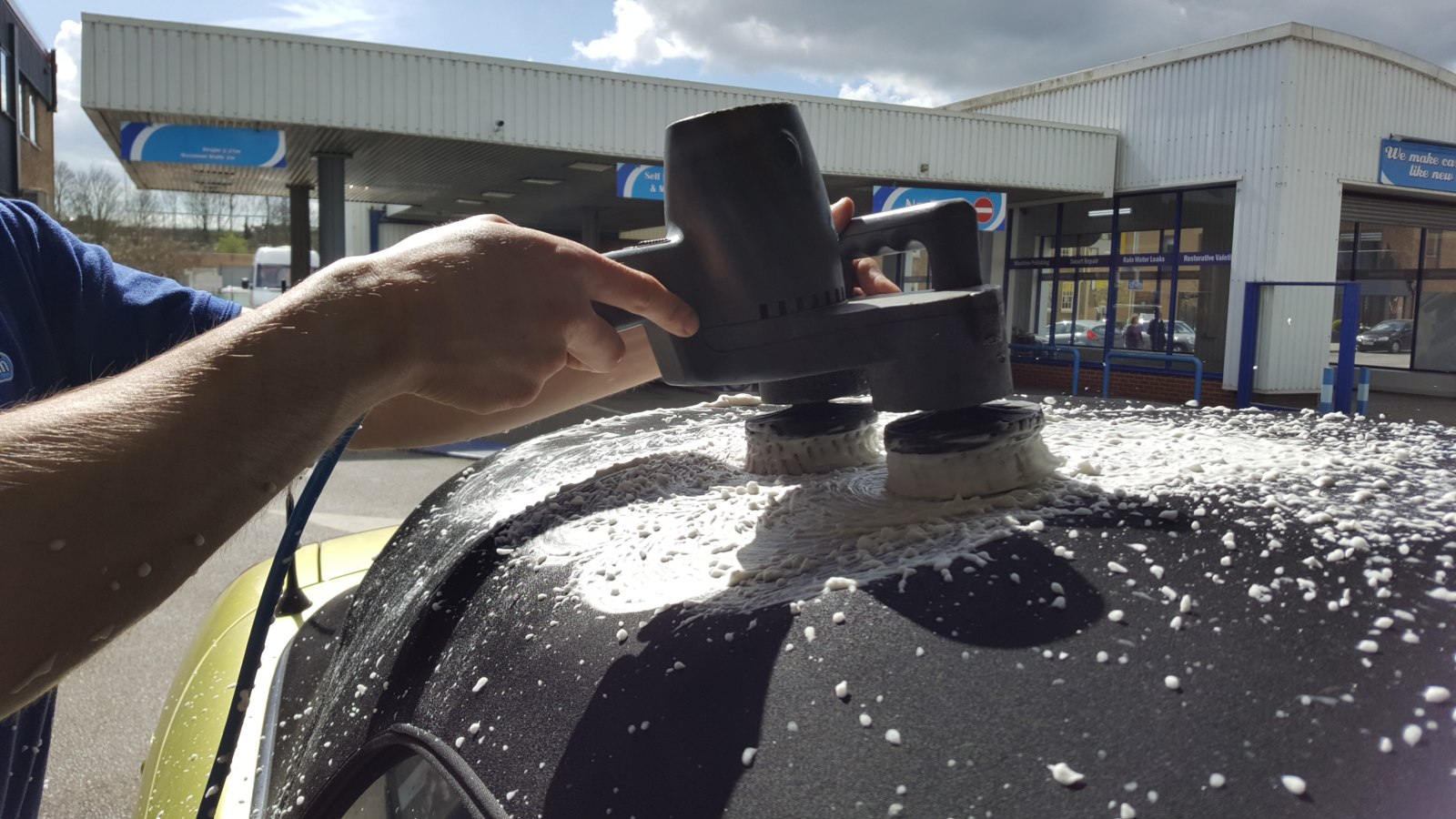
But the brush only earns its keep on the large flat panels. Seams, beading and any run of exposed stitching still has to be done by hand, with a smaller brush, because that is exactly where dirt collects and where a power head either skips over the low spots or risks fraying the thread. On a typical hood we reckon the machine handles maybe two-thirds of the surface and the last third -- the fiddly third -- is all hand work.
What this means if you're doing it yourself
Put the three pieces together and the picture is clear. The cleaner is the least important variable. A decent fabric soft-top product like Renovo, mixed to the strength on the label, will do everything the surface needs. Spend your money there rather than chasing a "professional" formula that doesn't exist as a retail product.
Then budget your effort honestly. Pre-treat any bonded contamination with a tar-and-bug remover first. Work the cleaner in with a brush -- a stiff-ish fabric brush, not a wash mitt -- because without agitation you're just rinsing the surface. Do the seams and stitching by hand. Rinse thoroughly so no detergent dries in the weave, and watch where the run-off goes so it doesn't sit on seals and trim.
Done properly, that is a genuine afternoon's work on a neglected hood. Done with a spray bottle and a quick wipe, it looks better for a fortnight and then the grime that was only loosened, never lifted, settles straight back in. The bottle on the shelf was never the thing standing between a clean roof and a dirty one. The agitation was.