What are the dark lines that are on my roof?

Quick answer: They are "tramlines" -- wear marks running along the lines where the hood folds. Gritty dust works its way into the fabric and abrades the fibres every time the roof goes up and down. The roughed-up fibres have a different texture, so they catch the light differently and read as darker. Cleaning and re-proofing darkens the rest of the hood and closes the contrast gap, but the marks themselves cannot be completely erased.
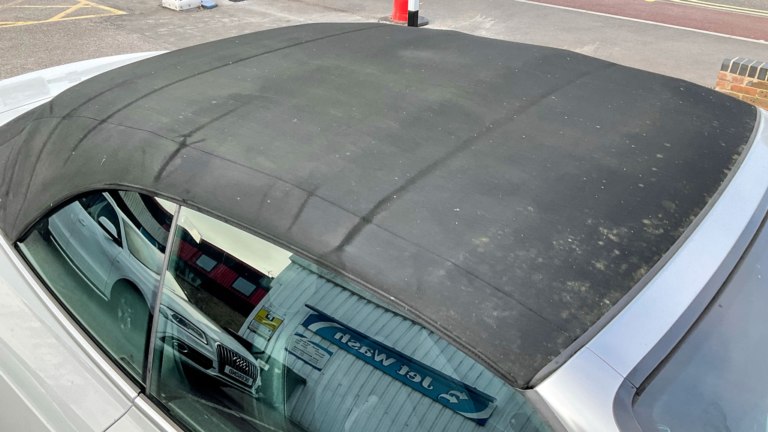
Those dark lateral lines on your roof are wear marks, and they nearly always follow the same geometry: straight across the hood, exactly where the fabric folds. The fibres along those lines are roughed up and sit at a different angle to the rest of the fabric, so they reflect light differently and your eye reads them as darker. Because the difference is texture rather than colour, there is a limit to what anyone can do about them -- and that surprises a lot of people who assume it is simply dirt that a good wash will lift.
Why they line up with the roof, not with your life
The giveaway is the geometry. Spills, bird mess and tree sap land at random; tramlines never do. They run dead straight across the hood and they map onto the folds of the roof mechanism. That is the first thing we point out when someone brings a car in convinced they have spilt something or that the dye has failed.
What is actually happening is mechanical. Gritty dust and pollen settle on the roof and work their way down into the weave of the soft-top. Every time you fold the hood down and put it back up, the fabric creases hard along the same lines, and the trapped particles grind against the fibres at those creases. Over months and years the fibres flatten, splay and fray. A frayed fibre scatters light instead of reflecting it cleanly, and scattered light reads as a darker, duller stripe. The colour of the fabric has not changed at all; only its surface has.
This is why two cars of the same age can look completely different. A car that lives outside under trees in a dusty spot, dropped and raised most fine days, will tramline far faster than one kept in a garage and folded a handful of times a summer. The grit is the abrasive and the folding is the action; take either away and the wear slows right down.
Mohair and vinyl wear differently
The roof material changes how obvious the marks are, though it does not make any folding hood immune. A mohair roof has a deep, directional pile, so abraded fibres show as a change in nap and tend to look like a soft shadow along the fold. A plainer vinyl roof or a flatter woven cloth shows them as harder-edged lines because there is no pile to soften the transition. Lighter hoods generally hide tramlines better than dark ones, where the contrast between worn and unworn fabric is starker. None of these escape it entirely; if it folds, it creases, and where it creases the grit does its work.
The honest answer on removal
People want to hear that there is a product or a machine that takes tramlines out. There is not, and we would rather say so plainly than sell you a treatment that disappoints.
A lint-shaver, run carefully over the worn lines, will lift and trim the loose raised fibres and genuinely take some of the edge off the contrast. It tidies the surface. What it cannot do is rebuild fibres that have already flattened and frayed, so it reduces the marks rather than erasing them. Roof dye is the other thing people reach for, and it is the wrong tool for this job: the problem is not a colour problem, so adding colour does not address the texture difference that is actually causing the dark stripe. Dye sitting on roughed-up fibres can even emphasise the line rather than hide it.
If a section is shaved too aggressively, or scrubbed hard with a stiff brush in the hope of "lifting" the mark, the thinned fibres tear. Now you have a split along the fold instead of a stripe, and a split is a repair job, not a cosmetic one. Backing off and accepting that the line will only fade, not vanish, is the right call almost every time.
What actually closes the gap
The most effective thing is also the least dramatic: get the hood properly cleaned and re-waterproofed. Cleaning does two useful things at once. It flushes the abrasive grit out of the weave so you stop grinding fresh wear in every time the roof moves, and the deep clean plus re-proof darkens and refreshes the surrounding fabric so it sits closer in tone to the worn lines. The contrast that made the tramlines jump out gets a lot smaller. The marks are still there if you go looking, but at normal viewing distance they fade into the hood rather than dominating it.
Re-proofing matters for a second reason. A hood that has lost its waterproofing holds dirt and damp in the fibres, and damp grit is more abrasive and clings harder than dry dust. Bringing the water-repellency back keeps the fabric cleaner between washes, which slows the rate at which new tramlines form.
Stopping the next set forming
Because the cause is grit plus folding, the prevention follows straight from it. A few habits make a real difference over the life of a hood:
- Brush loose dust off the roof before you fold it down, so you are not pressing grit into the crease.
- Avoid lowering the hood when it is wet or filthy; damp grit grinds hardest.
- Keep the waterproofing topped up so dirt sits on the surface rather than soaking into the weave.
- Where you can, park out of the worst of the dust and tree fall.
None of that reverses existing marks, but it slows the clock on the fibres you have left. Left completely alone, a hood that is folded often in a dusty spot keeps wearing until the fibres along the fold thin enough to tear, and holes along a crease line are a far bigger and more expensive job to sort than a clean and re-proof would ever have been. Tramlines are best thought of as the hood telling you it wants a service, not as damage to be scrubbed out.