What should you not do after ceramic coating?

Quick answer: Don't treat a ceramic coating like a force-field. Avoid the £5 brush wash and highly caustic soaps; don't smear the paint with dirty sponges or harsh cloths, and don't wash in hot, direct sun. Don't ignore bird mess or tree sap -- remove it promptly. And don't wash the car at all in the first week while the coating is still curing. If you must use a wash, choose touchless or soft; better to handwash with a suitable shampoo and dry afterwards.
A ceramic coating is tough, but it is not indestructible. Think of it as a hard, sacrificial layer sitting on top of your clear coat -- it takes the abuse so the paint underneath doesn't. That only works if you let it do its job, and a surprising number of owners undo good coating work in the first month without realising.
Most of what follows comes down to one idea: washing is what ages paintwork most, and a coating doesn't change the physics of a dirty cloth dragged across a panel. It just buys you a wider margin for error. Here is how not to spend that margin.
The first week is the part most people get wrong
A freshly applied coating is not fully cured the moment you drive away. The chemistry continues to harden over the following days -- typically the surface is touch-ready within a few hours but takes around a week to reach full hardness, depending on the product and the conditions it was cured in. During that window the coating is at its most vulnerable.
So for the first seven days or so: don't wash the car, don't park it under trees where sap and bird mess will land on a soft surface, and ideally keep it out of heavy rain if you can. We had a customer collect a freshly coated estate, drive straight to a supermarket, and come back to a single fat bird dropping that had sat on warm, half-cured coating for two hours in the sun. It left a faint etch ring we could still see under the light a fortnight later. On a fully cured coating that same dropping would have wiped off with a damp cloth and left nothing behind. Timing was the only difference.
If the car does get dirty in that first week, a gentle rinse with plain water is fine. Save the shampoo and contact washing until the coating has had time to set.
The £5 brush wash is the fastest way to ruin good paint
Once the coating has cured, the single biggest thing to avoid is the cheap automated brush wash. They work over the paint with stiff, dirty brushes that have scrubbed grit off a hundred cars before yours, and they pair it with highly caustic soaps designed to strip everything off fast. That combination is exactly what a coating is meant to protect you from, and feeding the car through one repeatedly will mark the surface regardless of what is on it.
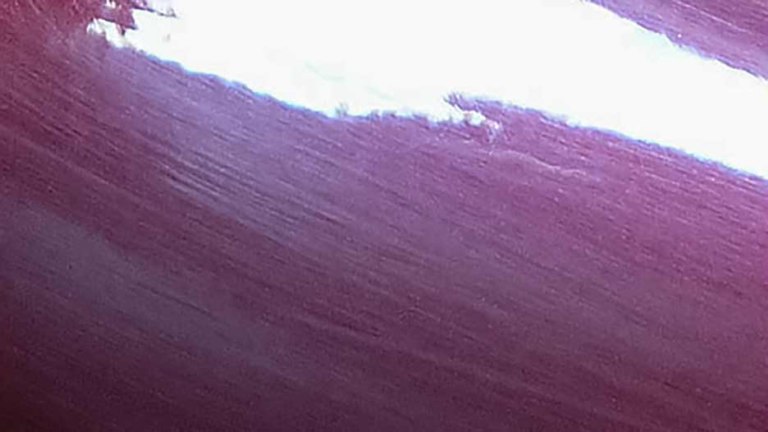
The marks in that photo are the classic signature: fine, swirling scratches concentrated on the high points of the panels, where the brushes press hardest. They build up slowly, so most owners don't notice until the car is parked next to a clean example under direct light. By then it is a polishing job, not a wash.
If you genuinely have no other option, find a touchless wash that relies on pressure and chemistry rather than physical contact, or at the very least a soft-cloth wash that is visibly well maintained. Neither is as good as washing the car yourself, but both beat the brush.
Don't reach for whatever cloth and soap is to hand
A coating makes the car easier to keep clean; it does not make the paint immune to a bad wash kit. The two everyday mistakes we see are dirty sponges and harsh cloths.
A sponge holds grit in its pores and drags it back and forth across the panel -- a kitchen sponge or a workshop rag is worse still. Washing-up liquid and other household detergents are the wrong soap: they are formulated to cut grease, and used regularly they will strip the coating's protective behaviour faster than a proper pH-neutral car shampoo. None of this will destroy a coating overnight, but it chips away at the very thing you paid for.
The fix is not complicated. Use a clean wash mitt, a dedicated car shampoo, plenty of water to keep grit moving off the surface rather than around it, and a soft drying towel at the end.
Don't wash in hot, direct sun -- and don't let it dry itself
Washing a hot panel in direct sunlight is a small mistake that shows up immediately. The water and shampoo flash-dry before you can rinse and dry them off, and they leave mineral spots and soap residue baked onto the surface. On a coated car those spots can be stubborn because the slick surface lets water bead and sit in fat droplets that concentrate the minerals as they evaporate.
Wash in the shade, on a cool panel, early or late in the day. And always dry the car afterwards rather than letting it air-dry -- a large, plush microfibre drying towel is one of the few bits of kit genuinely worth spending money on, because it lifts water off the coating with almost no contact pressure.
Don't ignore bird mess, sap and other contamination
The hydrophobic, easy-clean surface fools people into thinking the coating handles everything on its own. It doesn't. Bird droppings are acidic, tree sap is corrosive, and both are made worse by sun and time. A coating slows the attack and usually means the contaminant wipes off cleanly -- but only if you remove it reasonably promptly rather than leaving it to bake on for a week.
Removing it safely means softening it first: a spritz of water or quick-detailer, a minute to let it loosen, then a gentle lift with a soft cloth. Don't scrub at a dried-on deposit with a dry cloth, because at that point you are grinding whatever it left behind into the surface.
How easy washing actually looks
None of this means cleaning a coated car is a chore. The whole point of a coating is that it makes life easier, and most owners rightly don't want to turn a wash into a ritual. There is a sensible middle ground.
In that video Gary uses nothing more than a self-service jet wash -- including the brush provided -- and finishes with two very plush drying towels. It works because the coating releases dirt so readily that the pressure does most of the lifting, and the towels do the rest with barely any contact. That is the realistic version of low-effort maintenance: not zero care, just far less of it.
If you want to be more thorough, the two-bucket method is the gold standard: one bucket of shampoo, one of clean rinse water, grit guards in the bottom of each so the dirt you rinse off your mitt drops out of circulation instead of going back onto the paint. It takes a little longer, but it is the safest way to wash by hand and the difference shows over years rather than weeks.
The honest summary is simple. A coating widens your margin for error; it doesn't remove it. Skip the first-week curing window, the brush wash and the household sponge, dry the car properly, and deal with bird mess before it bakes on -- do that and the coating will keep doing its job for as long as it is meant to.