Can I use quick detailer over a ceramic coating?

Quick answer: Yes -- you can use a quick detailer on a ceramic-coated car. Pick a coating-safe product (usually SiO2-based), skip anything wax-heavy, and leave it off the paint while a fresh coating is still curing in its first week. It works well as a drying aid or to lift light dust between washes -- but it is not the tool for restoring water behaviour that has gone flat.
Yes, you can. Whether you should depends entirely on what you are hoping it will do, because a quick detailer and a ceramic coating are not really competing for the same job. One is a five-minute touch-up; the other is a layer of hardened protection meant to last years. Confusing the two is the single most common reason people end up disappointed with a product that was never going to do what they wanted.
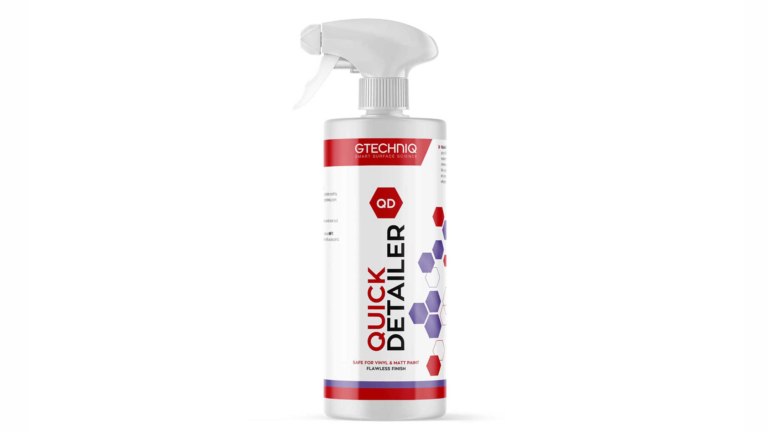
What a quick detailer actually is
It helps to know what is in the bottle. A traditional car wax contains two things doing two jobs: waxes for protection and longevity, and oils for shine and slickness. A quick detailer -- and its close cousin the show shine spray -- flips that ratio on its head. It is heavy on the oils and light on anything that protects. Most are a thin emulsion of lubricating polymers and light silicone fluids carried in water, sometimes with a touch of SiO2 added to the mix. That is why these products are so pleasant to use: a few sprays, a wipe with a clean towel, and the panel looks wet and glossy in seconds.
The catch is that the effect is shallow and short-lived. With nothing much to bond to the surface, the gloss a quick detailer adds tends to last days rather than weeks. Those light silicones sit on the surface, fill micro-texture so light reflects more evenly, and then wash away the next time it rains. That is by design; a quick detailer is meant to be a cosmetic top-dressing, not a coat of armour. Some products include a mild cleaning agent on top of the oils, which is where the dry-wash type products sit -- enough lubrication to lift light dust safely, but never a substitute for a proper contact wash on a dirty car.
Will it harm the coating?
No. A coating-safe quick detailer will not damage a cured ceramic coating, and the better ones these days are formulated with SiO2 chemistry specifically so they sit comfortably on top of a coating rather than fighting it. The one thing worth keeping an eye on is residue. Oil-rich sprays can build up a faint film over repeated use, especially if you are heavy-handed with the trigger, and that film occasionally shows as smearing in low sun. It almost always lifts off at the next wash, so it is a cosmetic niggle rather than a real problem.
The products to be wary of are the wax-heavy "spray wax" hybrids and the cheap silicone-laden dressings. They will not hurt the coating either, but the layer they leave can interfere with how the coating sheds water and can make the surface feel greasier than slick. Heavy silicone dressings are the worst offenders here: they smear a soft, oily film over the coating that masks the very thing you paid for, the tight, self-cleaning water behaviour of the coating underneath. If the label leans on wax content or generic "shine" silicones as a selling point, it is the wrong choice for a coated car. Reach for something that names itself as coating-safe or ceramic-compatible instead.
Choosing a coating-safe quick detailer
The shelf is crowded and the labels are not always honest, so it is worth knowing what to look for. The cleanest signal is a product that explicitly states it is coating-safe, ceramic-compatible, or SiO2-based; a manufacturer that has tested it on coatings will say so plainly. After that, read what the product leans on. A QD that sells itself on "deep carnauba shine" is wax-heavy and wrong for a coated car. One that sells itself on "slickness" and "ceramic boost" is the right family.
A simple test once you have one home: spray a little on a coated panel, buff it off, then flick water at it. If the water still beads and runs in tight droplets, the product is sitting politely on top of the coating. If the water suddenly sheets flat and clings, the product has smothered the hydrophobic layer with oils and you have the wrong bottle. Keep it for your trim or wheels and pick something lighter for the paint. The price tag is a poor guide here; some of the worst offenders for greasy silicone fill are mid-priced "all-in-one" sprays, while plenty of honest coating-safe QDs cost very little.
The mistake we see: using it to chase lost beading
This is where most people reach for a quick detailer for the wrong reason. A coating beads tightly when it is new, and after a year or so that response usually softens. The instinct is to spray something glossy on and hope the water behaviour comes back with it.
Tom, our operations manager, has a useful observation on this. Every coated car that comes back to us a year or two down the line has some level of contamination sitting on the surface -- traffic film, mineral deposits from hard water, a bit of bonded fallout -- and that contamination is almost always what is dulling the beading, not the coating wearing out underneath it. A quick detailer lifts the loose dust and lays a thin gloss over the top, so for a day or two it looks like it has worked. Then the next rain shows the water sheeting flat again, because the actual contamination is still there.
What actually restores the behaviour is a proper decontamination wash to strip what has bonded to the coating, followed by a ceramic-compatible topper. The topper is engineered to bond a fresh hydrophobic layer onto the coating; a quick detailer simply lays oils on top that rinse away within days. They look similar in the bottle and on the shelf, but they are doing completely different jobs.
Maintenance tool, not a protection layer
This is the distinction worth fixing in your head before you buy anything. A quick detailer is a maintenance tool. It makes drying faster, lifts light dust between washes, and adds a brief lift of gloss for a show or a photo. It does none of the things a coating or a topper does: it offers no meaningful protection against UV, road salt, bird lime or industrial fallout, and it does not bond to the paint in any lasting way.
You will sometimes see a QD marketed as if a regular wipe-down "maintains" or "tops up" your coating. Treat that gently. Spraying a coating-safe QD over the paint does no harm and can leave the surface feeling slick and looking fresh, but it is not adding to the coating or extending its life in any structural sense. The protection is the cured coating; the QD is housekeeping on top of it. If your coating's water behaviour has genuinely worn rather than just dirtied, the answer is decontamination and a topper, not more QD. Keeping those roles separate is what stops people overspending on the wrong product and underspending on the right one.
If you do use one, use it well
For its proper purpose -- a drying aid after a wash, or a quick lift of light dust between washes -- a quick detailer is a genuinely good tool to keep in the boot. A few habits keep it working in your favour rather than against you:
- Only ever spray onto clean paint. On grit or dried-on dirt, the oils just smear contamination across the panel and risk marring.
- Use a clean, plush microfibre towel, and turn or swap it the moment it stops gliding.
- Use less product than feels right -- a light mist over a damp panel does far more than a soaked one, and leaves no residue to chase.
- Leave it off entirely during the cure time of a fresh coating, which is usually the first week. The coating needs that window to harden undisturbed.
Get those right and a quick detailer earns its place: it makes drying quicker and gentler, keeps a coated car looking sharp between washes, and does no harm to the protection underneath. Just keep its job and the coating's job clearly separate in your head. The coating handles the long-term gloss and protection; the quick detailer is for the in-between moments, nothing more.
For the wider picture on keeping a coated car right -- wash technique, frequency, and what to avoid -- see how to wash a car with a ceramic coating.