What is Wash'n'Wax?

Quick answer: A wash-and-wax is a car shampoo with wax additives that cleans while leaving a thin protective layer. It boosts gloss and water beading in one step, but the protection is short-lived. Think of it as topping up between proper waxing, not a substitute for it.
Wash'n'Wax was a product made famous in the UK by Turtle Wax, but "wash and wax" is really the name given to a whole category: two-in-one shampoo-and-wax products. Once one brand proved the idea sold, the rest followed, and today every major car-care label puts a version of it on the shelf. They all do much the same job.
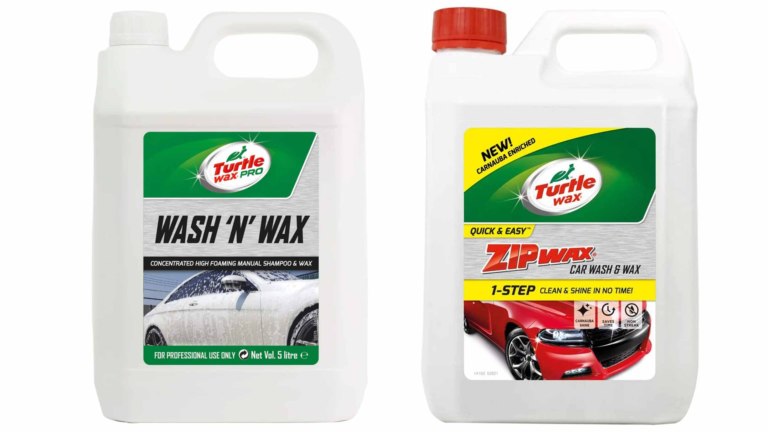
How it works in the bucket
You use it exactly as you would any other car shampoo: a couple of capfuls in a bucket of warm water, then wash the car normally with a wash mitt. The difference is in what stays behind. As you rinse and dry, the shampoo deposits a thin film of wax (or, more often these days, a synthetic polymer) across the panels. That film is what gives you the extra shine and the bit of water beading you notice afterwards.
The protection is not long-lived. A couple of weeks of British weather and it has mostly washed away. The assumption built into the product is that you will reach for the same bottle again next time you wash the car, so it does not need to last. That is the whole logic of the category: little and often, rather than one heroic afternoon with a tin of carnauba twice a year.
What is actually in the bottle
It helps to picture two jobs happening at once. The first job is cleaning: surfactants lift road film, traffic grime and the salty spray of a British winter off the paint and hold it in suspension so it rinses away rather than smearing back across the panel. The second job is depositing: a small load of protective ingredient that does not rinse away cleanly but clings to the now-clean surface as the water sheets off.
That protective ingredient used to be natural carnauba or a soft mineral wax, which is where the name came from. These days most formulas have shifted to synthetic polymers, often silicone-based or acrylic, sometimes with a dash of the same silica chemistry that the coating world has made fashionable. Polymers bond to clean paint more readily than wax does, they survive a few more rinses, and they are cheaper to blend at scale. The marketing still says "wax" because the word sells; the chemistry has quietly moved on. For the everyday user it makes little practical difference, beyond the polymer versions tending to bead a touch longer and look a little glassier than the old soft-wax ones.
The reason the protection stays thin is built into the design. A shampoo has to rinse off, by definition, or it would leave you with a streaky, hazy car. So the deposit has to be light enough to go almost unseen yet just substantial enough to bead water and add a little gloss. That balancing act is why a wash'n'wax can never lay down the thickness of a dedicated paste wax or sealant: the cleaning and the protecting are fighting each other in the same bucket, and the cleaning has to win or the product fails at its first job.
Why we recommend them anyway
We recommend wash'n'wax products, but not for the level of protection they give. We recommend them because they are so easy. They are even easier than spray-on waxes, where you have to stop, mist the panel, then buff. With a wash'n'wax the protection arrives as a side-effect of a job you were doing anyway. And the easier a job is, the more often it actually gets done.
That is the point most people miss. A car washed every fortnight with a humble two-in-one shampoo will, over a year, look better and stay better protected than a car that gets one immaculate hand-wax in spring and then nothing until autumn. Consistency beats intensity. The best wax is the one you will actually keep using.
They layer happily over other things, too. You can use a wash'n'wax over the top of a long-life paste wax, a polymer sealant, or even a ceramic coating (with one caveat we will come to). Dry the car properly with a good-quality microfibre towel and you should get a clean, streak-free finish across paintwork, glass, chrome, plastic and rubber alike.
Who it is really for
Be honest with yourself about the kind of owner you are, because that decides whether this product is right for you. If you are someone who genuinely enjoys a Saturday spent claying, polishing and laying down a proper carnauba by hand, a wash'n'wax is a between-times convenience rather than your main protection. You already have the patience for the slower route, and you will get more from a dedicated wash followed by a dedicated wax.
But most people are not that owner, and there is no shame in it. The far larger group wants a clean, presentable car with a bit of shine and a bit of water-shedding, and wants to achieve it without giving up half a weekend. For that owner the wash'n'wax is close to perfect: it removes the decision, the extra step and the extra cost, and it folds protection into a chore that has to happen anyway. The occasional waxer who keeps meaning to get round to it, and never quite does, ends up far better served by the two-in-one bottle than by the expensive tin of wax sitting unopened on the garage shelf.
The same product you meet at the jet wash
If standing in the drive with a bucket is not your idea of a Sunday, you have already met this product without realising it. The "wax" button at the coin-op jet wash, and the wax cycle on an automated rollover, dispense essentially the same two-in-one chemistry, just pumped through a machine instead of a mitt. It is not as thorough as a proper hand wash, and the brushes on some automatics do the paint no favours, but the wax stage itself is the same idea: clean and leave a thin film in one pass.
It is still just shampoo underneath
Across this site, and from any other source of sensible car-care advice, you will hear the same refrain: use a pH-neutral shampoo made for cars, never washing-up liquid. Wash'n'wax products are exactly that. Strip away the marketing and you have a good-quality pH-neutral shampoo with some extra ingredients riding on top. So you are not trading away the basics to get the convenience; you are getting a sound shampoo that happens to leave a little protection behind. There is no real downside to the chemistry for normal use.
Two-in-one versus doing it properly
It is worth being clear about what you give up when you take the easy route, so the choice is an informed one rather than a default. Wash the car with a dedicated pH-neutral shampoo and then apply a dedicated wax or sealant afterwards, and you get two advantages the bottle cannot match. First, the wash shampoo is free to be a pure cleaner, with no protective load fighting it, so it strips the panel back to genuinely clean before anything is laid down. Second, the wax goes on as a deliberate, even layer onto that clean surface, cured and buffed, several times thicker and far more durable than the whisper of polymer a shampoo can leave behind. The result is more gloss, deeper reflection, and beading that lasts months rather than a fortnight.
The cost is time, a second product, and a second step every few months. The wash'n'wax collapses all of that into one capful, and accepts a thinner, shorter-lived result as the price. Neither approach is wrong; they answer different questions. The separate route asks "how good can the finish be?"; the two-in-one asks "how do I keep some protection on the paint with the least possible effort?". Most cars on most driveways are better served by the honest answer to the second question than by the aspirational answer to the first, because the aspirational answer so often ends in a car that never gets waxed at all.
The one caveat: ceramic-coated cars
The exception is a car that already wears a ceramic coating. Here, using a wash'n'wax every single week is not harmful, but it is quietly counter-productive. The wax residue builds up as a layer sitting on top of the coating, and over time it masks how the coating itself is performing. You end up judging the wax, not the ceramic you paid for. If the beading suddenly drops off, you can no longer tell whether the coating has failed or whether you are just looking at tired wax.
There is a second, subtler issue. A good ceramic coating sheds water by its own slick, low-friction surface chemistry, and a wax film laid over the top changes that surface. You are no longer feeling the coating do its job; you are feeling the wax doing a weaker version of it, on top of something that was already better. For a coated car the sensible shampoo is a plain pH-neutral one with no additives, so the coating is left to perform on its own merits and to be judged honestly.
Tom, our operations manager, sees this come through the workshop more often than you would think: a customer worried their expensive coating has "stopped working" after a year, when in fact the coating is fine and the problem is a fortnight-by-fortnight build-up of two-in-one wax sitting over the top of it. A proper decontamination wash strips the residue back, the coating beads exactly as it should, and the panic evaporates. So on a coated car we keep wash'n'wax for the occasional top-up rather than the weekly routine. For the recommended weekly approach on a coated car, see how to wash a car with a ceramic coating.
Where it fits
So: is wash'n'wax worth buying? For most cars, yes. It is cheap, it is foolproof, and it removes every excuse not to keep a bit of protection on the paint. Just be clear about what it is and is not. It is a maintenance product that keeps a car looking cared-for between proper detailing jobs; it is not a replacement for a real paste wax, a sealant, or a coating, none of which it can match for durability or depth of finish. Used for what it is good at, on a car that is not already coated, it is one of the easiest wins in car care.