How long will a ceramic coating last?

Quick answer: Longer than the label says, and in our experience the coating itself does not come off. Published figures run from six months to ten years depending on who is quoting them, which tells you the number is not really a property of the coating. What changes is the water behaviour, not the film underneath it. When a coated car stops beading, the cause is usually contamination sitting on a coating that is still perfectly present.
This page takes the technical view of the question: what the published numbers are actually measuring, which claims survive scrutiny, and what we see on cars that come back. For the case in plain language, with the stories behind it, read how long do ceramic coatings really last? on the blog.
The published numbers disagree with each other
Look up the answer and you will be told a professionally applied ceramic coating lasts two to five years, or three to seven, or five to ten, or six months to ten years. Those are real figures from real suppliers and installers, published in the same month, about the same category of product. One page we read gave two different answers to its own question.
A measurement that credible sources put anywhere between six months and ten years is not a measurement. It is a positioning statement. And the number has a habit of rising when the person quoting it sells the coating: the general figure is five years, the flagship is ten, and the flagship belongs to the author. Where those figures come from, and why the honest ones are conservative, is in how do you know how long a ceramic coating lasts.
There is a second tell. The same sources that promise five to ten years also tell you to apply a booster every few months and have the car detailed twice a year. Both cannot be the headline. If the finish needs topping up quarterly to keep working, then the ten-year figure is describing the film still being present rather than still performing, and the customer is being sold two incompatible promises at once.
Where the number actually comes from
Manufacturers do not coat a car, wait ten years and print the result. The figure is assembled from laboratory accelerated weathering, where samples take concentrated UV, chemical exposure and wash cycles in a fraction of the real time; field trials on test cars in a handful of climates; and feedback from accredited installers seeing customer cars over the years. A margin is then built in, because no manufacturer wants a queue of owners demanding a free re-coat.
What that process produces is a comparison, not a prediction. A brand's entry product may be positioned at roughly half the durability of its flagship, and the warranty expresses the gap between them. Read "five years" as "should outlast the two-year product under the same conditions" and it is genuinely useful. Read it as a date and it is meaningless, because the conditions on your car are not the conditions in the cabinet.
Manufacturers are not especially comfortable with it either. More than one has told us they would rather not print years on a product at all. The difficulty is that years is the only thing you can put a number against: it is a meaningful measure, unlike some of the figures on the label, but it is an estimate, and the variables that move it belong to the car rather than the bottle. Layer count is another figure that gets sold as durability; how many layers of ceramic coating does a car need puts it in proportion.
It is worth knowing that the chemistry is not new either. These coatings grew out of protective systems proven in aviation and industry long before anyone put one on a car, and an early automotive product was demonstrated to us more than fifteen years ago. The category has had long enough to settle the durability question. That it has not been settled is a marketing problem rather than a scientific one.
Two different things get called wearing out
Most of the confusion in this subject comes from one word doing two jobs.
The first thing is the film: the cured layer bonded to the clear coat. In our experience that does not leave. We have not seen a coating we applied crack, peel, flake or wear back to bare paint, and we have been doing this long enough to expect that we would have by now.
The second thing is the surface behaviour: the tight beading, the fast sheeting, the slickness under a wash mitt. That is a property of the outermost molecular skin, and it genuinely does change. It is also the only part most owners can see, which is why "my coating has worn off" almost always means "my car has stopped beading".
Keep those two apart and the industry's numbers make sense. The long figures describe the film. The maintenance advice describes the surface. Nobody says which one they are quoting because the confusion sells product.
Which half of the benefit are you actually losing?
A coating sells two things at once, and they do not have the same lifespan. One is protection: a hard, chemically resistant layer sitting over the paint. The other is low maintenance, the part owners notice daily, where the car stays cleaner for longer and washing takes half the effort.
When water stops beading, it is the second one that has gone. The protection is still there, because the film is still there. That distinction matters commercially as well as technically, because most of what a coating costs is not the coating. It is the hours of machine polishing that go in beforehand, correcting the paint so that the coating locks in a finish worth locking in.
That work does not have to be repeated. A car whose coating has stopped behaving can usually be brought back without going through the correction again, which is why recovering one costs a fraction of the original job. The disappointment owners feel when beading stops is real, and it is about the half of the benefit they enjoy most. It is also, in most cases, the half you can have back.
Does a harder coating last longer?
Strip the marketing away and every coating in this category is much the same thing: a resin, a ceramic, and a sprinkling of other ingredients. What separates them is the recipe, and the ingredient currently doing the heaviest lifting in advertising is silicon carbide, with the claim attached that formulas containing it last up to a decade.
Silicon carbide is an additive rather than a substitute. It goes in alongside the rest, in the same way graphene or titanium does, and in theory it should produce a harder, tougher coating. We would not state that as fact; it is what the chemistry suggests rather than something we have watched happen on a panel.
What the claim leaves out is that silicon carbide is not especially hydrophobic. The coating will still bead water, because other components in the mix do that job, but the silicon carbide is not what keeps the beading going. So even taking the hardness claim at face value, it is answering a question nobody asked. Hardness helps a film survive contact; it does nothing for the property owners actually judge a coating by, which is the one that fades first.
Does more ceramic mean a better coating?
The other figure in circulation is silica content, with manufacturers competing to claim a higher percentage than each other. We put this as a question because we cannot answer it definitively, and neither, as far as we can tell, can anybody else in public.
What we can say is that we are not convinced. It reads to us a little like saying more cement makes better concrete: the mix has to be right, different mixes give different properties, and there are trade-offs between them. A number that goes up is not automatically a coating that gets better.
It has something of the megapixel arms race about it, though the comparison is not exact, because silica content is a meaningful figure rather than a vanity one. The problem is what it is being asked to prove. What we go on instead is how the car looks with the coating on it, and whether the customer comes back with a complaint two years later. Those are the only two tests that have ever told us anything useful.
What decides it on a particular car
Since the film stays put, the useful question is what changes the surface behaviour, and that is mostly mechanical and chemical load rather than time.
Where the car sleeps matters. A garage removes UV, frost, sap and overnight dew, and those are the loads that alter a surface. A car cover is a different proposition and we advise against them: dragging fabric on and off grinds whatever has settled onto the paint, wind works the cover against the panels, and they trap condensation underneath. The cases where a cover earns its place are narrow. It is also worth remembering what people buy a coating for, which is so they do not have to baby the car.
Water does more damage than most owners expect, and hard water is the main culprit we see. Minerals left behind when droplets dry are difficult to remove and a coating does very little about them; it is a surface for the water to sit on, not a defence against what the water leaves. Water spots are a genuine weakness of coated cars rather than a marketing invention.
The extreme version arrives when the Sirocco carries dust north from Africa and drops it across the country as a pink film. Wetted by rain or dew it behaves somewhat like cement, setting on the surface rather than rinsing off it. Nothing stops that landing on the car, and a coating does less for you here than almost anywhere else.
Environment follows on: coastal salt, motorway mileage, industrial fallout and building sites all deposit more of what has to be washed off.
Then the wash routine, which owners underestimate more than anything else. pH-neutral shampoo and soft mitts preserve the surface; strong alkaline traffic film removers at trade dilution strip it in a single pass, and automatic brushes abrade it. Prompt removal of bird mess and sap matters for the same reason: the coating slows chemical attack but does not stop it.
Finally the paint underneath, which nobody mentions. A coating is a thin layer following the surface it was applied to. On soft paint that marks easily, the coated finish will show wash marring sooner than the same product on hard paint, and the owner will read that as the coating failing.
When a coated car stops beading, start with contamination
The signs are easy to read. Beading softens into larger, lazier beads, rinse water sheets more slowly, the car stops looking freshly rinsed after rain, and the mitt no longer glides.
The industry reads that as the coating wearing out and sells a product to fix it. In the cars that have come back to us it is nearly always bonded contamination lying on the coating: iron particles, tar and hard-water minerals building a film that water sits on instead of the coating. Take that layer off with a proper decontamination and the behaviour returns, because the coating never went anywhere.
So the order matters. Decontaminate first, then judge. If the water behaviour comes back, nothing was wrong and nothing needed buying. If it genuinely does not return once the surface is clean, that is the point to consider a top-up product. You do not need an instrument to make that call. You need a clean car and your own eyes; a coating that looks right and sheds water is working, and one that does not is not, and no measurement changes either answer.
What has actually come back to us
The field record is worth more here than any laboratory figure. Very few customers have come back unhappy, and we have cars out there well past five years that still look new on minimal work.
The clearest example is a customer who brought us a second van six years after the first. The original Matrix Black had covered roughly 255,000 miles of daily business use in that time, in all weathers, washed the way a working vehicle gets washed. It was still doing its job when the new van arrived for the same treatment, which is why we filmed the two vans side by side. Anyone can photograph a car on the day it is finished; six years and a quarter of a million miles is the test that means something.
The complaints we have had are almost all the same complaint: the car has stopped beading. In a couple of cases the cause may have been our own process, with the coating not curing as it should have. We put those right, and in honesty we were never able to pin down exactly what went wrong. In the rest the coating was intact and the problem was contamination, which is why the decontamination step above is the first thing we reach for.
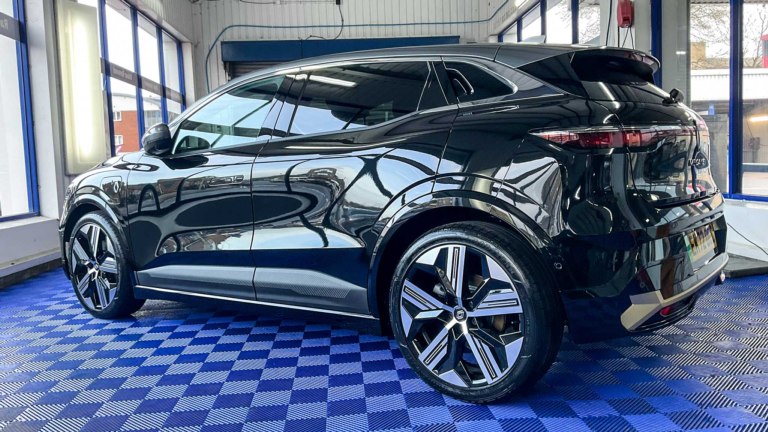
This Porsche Taycan came back to the workshop twenty-six months after we applied Matrix Black, for a routine maintenance wash. We filmed it with no extra preparation, to show what a coating looks like with real use behind it rather than on handover day.
Context
Our position, stated plainly: once a coating is on, it is on for good. The honest question is not how many years it lasts but whether it is still behaving, and when it is not, the cause is usually a cleaning problem rather than a coating problem. That is a less satisfying answer than a number, which is precisely why the industry prefers the number.
If a coating on your car has stopped performing after a proper decontamination, what happens when a ceramic coating wears off? covers the practical options. For what a coating protects against, see what are the benefits of a ceramic coating?