How long does it take to clean and proof a hood?

Quick answer: Done professionally, a clean and weatherproof is usually a one-day job. We shampoo, scrub and rinse repeatedly until the water runs clear, then the hood has to be bone dry before any coating goes on. Drying swings with the weather: about half an hour in summer with fans and air lines, a few hours in winter. The coating then needs time to cure before you use the car. Tackled as a DIY job, the same work realistically spreads over several days.
There are really two jobs hiding inside the question. The first is cleaning the roof until the rinse water runs clear; the second is bonding a weatherproof coating to a bone-dry soft-top. With the right kit and a heated bay we turn the whole thing around inside a day. Done at home, on a driveway, with a brush and a bottle, it becomes a multi-day project -- and that gap is mostly about drying, not effort.
The cleaning stage: keep going until the water runs clear
How long the wash takes is governed by one thing -- how dirty the roof is when we start. When we clean a roof, the finish line isn't a number of minutes; it's the colour of the rinse water. We keep shampooing, agitating and rinsing until the suds stay bright white and the water coming off the weave runs crystal clear. On a roof that has been left to weather for a few years, that can mean working the shampoo through the fabric, scrubbing and rinsing five or six times over before it gives up its grime.
The reason it can take that many passes is that dirt in a fabric hood isn't sitting on the surface like it does on paint -- it's worked down into the weave. Each pass lifts another layer. Stop too early and you trap that dirt under the coating, which is the one mistake you can't undo without starting again.
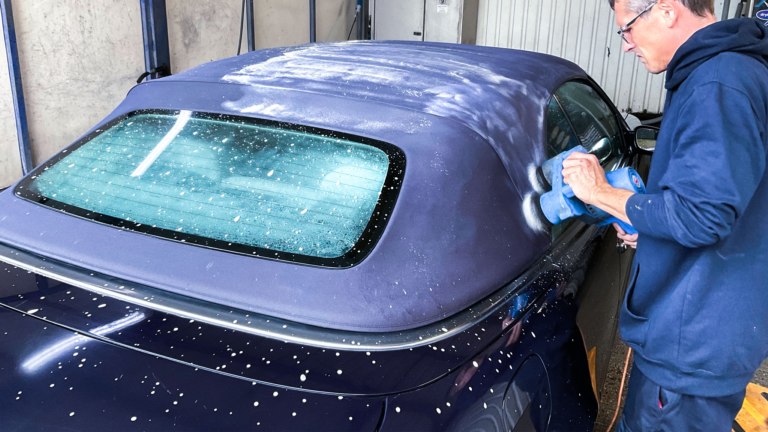
Speed is where the kit earns its place. We use machines that agitate the fabric far faster and more evenly than a hand and a brush ever could, which is why a job that would have a DIYer scrubbing on and off for an afternoon is, for us, a steady and predictable part of the day.
A roof that has been cleaned and maintained regularly is a different story. If it's only picked up a season of light grime, two passes will often have the water running clear. Two is the minimum we'll ever do, though -- even a clean-looking roof gets a second pass to be sure.
Why a damp hood is a wasted afternoon
Once the fabric is clean, the next stage is applying the waterproof coating -- and this is where most home jobs come unstuck. Water and weatherproofing simply don't mix. The coating works by bonding to the fibres of the fabric; if those fibres are still holding moisture, the coating can't grip and you end up with patchy beading that fails within weeks.
So the fabric roof has to be bone dry, all the way through the weave, before a drop of coating goes near it. Not surface-dry to the touch -- properly dry. That single requirement is the reason the job stretches across days at home: you've done all the hard scrubbing, the roof looks finished, and then you have to wait.
How long drying actually takes
Drying time is dictated by temperature and humidity, and the swing between a good day and a bad one is dramatic. In summer we can have a soft top bone dry in half an hour: we run an air line over it to blow the standing water out of the weave, then park the hood under a fan to pull the last of the moisture out. In the depths of winter, with cold air that's already close to saturated, the very same roof can take a few hours to reach the same point -- and that's with our heated bay and forced air working in our favour.
This is the part of the day a driveway can't replicate. Without an air line to force water out of the weave and a fan to keep air moving, a home job is left waiting on the weather. On a still, damp British afternoon a hood can sit visibly wet for the rest of the day, which is why we tell anyone tackling it themselves to plan around the drying, not the cleaning.
Letting the coating cure before you drive
Applying the coating is quick; letting it set is not something to rush. Once the weatherproofer is on, it needs time to cure -- to fully bond and harden into the fabric -- before the car goes back into use. Putting the roof down, driving in rain or even parking under trees too soon can disturb the coating before it has keyed in, undoing the work. Our notes on cure time cover what to avoid during that window; the short version is that the coating wants to be left undisturbed, ideally somewhere dry and sheltered.
A workshop day against a DIY weekend
Put the stages end to end and the difference between the two routes is clear. In the workshop, cleaning, controlled drying and coating fit comfortably inside a single working day, because the two slow steps -- getting the weave fully clean and getting it fully dry -- are handled by machines and a climate we control rather than by patience and good weather.
At home the same work doesn't get harder, it gets longer. Realistically it becomes a project you run over a weekend or more: a session to clean it properly across several passes, a long wait for the fabric to dry all the way through, and then the coating and its cure. None of that is a reason not to do it yourself -- plenty of owners do, and do it well. It's simply a reason not to treat it as a single-afternoon chore. Rush the cleaning and you seal in dirt; rush the drying and the coating won't take. Take your time on both and the result will last.
One shortcut worth ruling out before you start: running the car through an automated car wash first does nothing useful. Those machines are built for painted panels, not fabric, and the brushes and detergents can lift weatherproofing off the roof without ever cleaning the weave underneath -- so you arrive at the real job having stripped the protection but kept the dirt.