Why do you want to Krytox my rubbers?

Quick answer: Aged or dirty soft-top seals compress and stop sealing. We flush the drains and condition the rubbers with Krytox to restore flexibility and plump them back into shape, so they shed water again and help prevent leaks, damp smells and steamed-up windows. Far cheaper than replacing the seals -- unless they are cracked or split.
All cars leak; convertibles just give water far more ways in. Worn rubbers are one of the most common culprits we see, and a tub of the right conditioner solves more leaks than most owners expect.
Why a convertible leans so heavily on its rubbers
A convertible is not a saloon with the roof cut off. The body shell is engineered differently: no fixed door pillars, no metal window surrounds, and usually a trough at the back that the hood folds into. On a hard-top, the steel structure does most of the sealing work and the rubber is a backstop. On a soft-top, the rubber is the structure of the seal. There is nothing else holding the weather out.
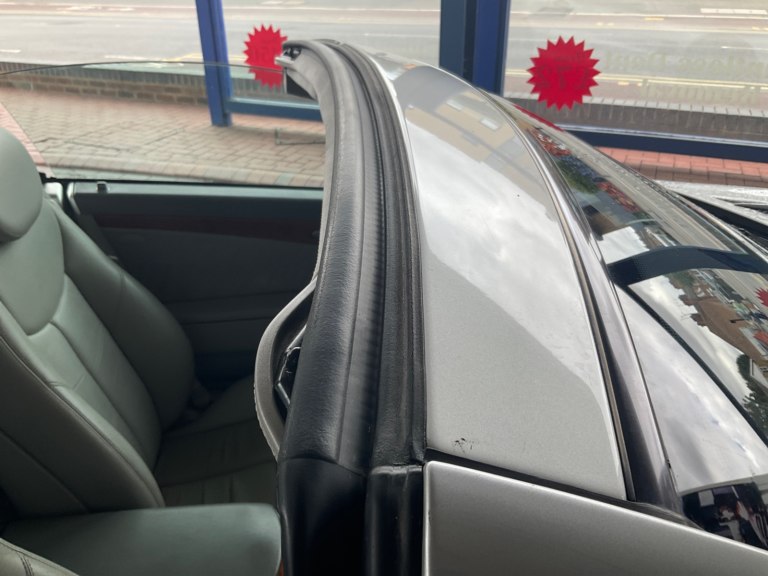
When the soft-top is up, it latches above the windscreen and the side windows press against rubber seals. Even that is not enough on its own. Those seals usually have channels moulded into them to drain water away from the doors and windscreen, and to stop puddles forming in the rear scuttle. Water is not just kept out; it is actively steered to where it can run away. That only works while the rubber is the right shape.
How a healthy seal turns into a leak
Rubber and neoprene fail in two ordinary ways, and most cars suffer from both at once.
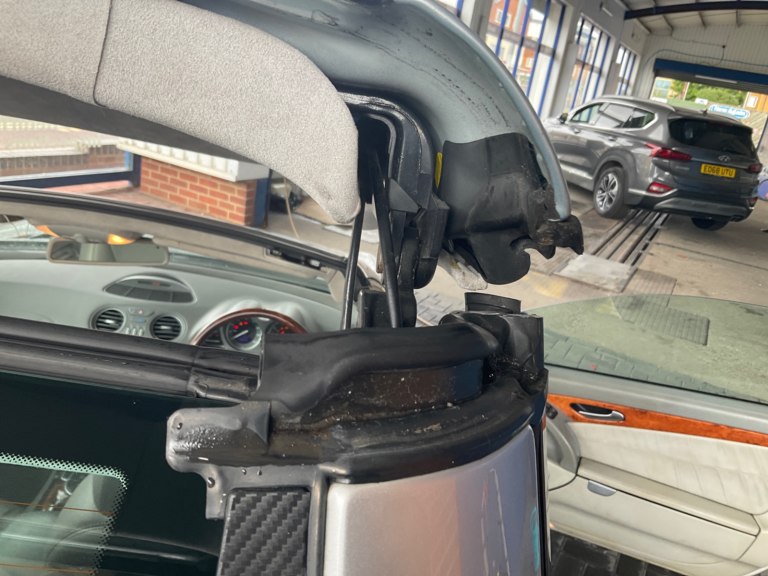
The first is grime. Pollen, road film, leaf mulch and old polish build up on the contact face. The seal still looks fine, but it can no longer mate cleanly against the glass or the body; it sits on a thin crust of dirt instead of compressing into a watertight line. The second is ageing. Rubber that spends years squashed under a parked roof takes a set: the plasticisers that keep it supple migrate out, it hardens, and it stays flattened in the compressed position rather than springing back. A flattened seal has no give left to fill the gap, so water tracks straight past.
Once water is getting in, the cabin tells on itself quickly. The carpets hold damp, the glass steams up on every cold morning, and the car starts to smell like a pond. Worse, the water rarely stays where it landed. It runs to the lowest point it can find, and in a convertible that is often the floor pan where control modules and connectors live. We have pulled footwell trim on cars brought in for an intermittent electrical fault and found a connector sitting in a teaspoon of standing water; the owner thought the car had a wiring gremlin, when the real fault was a seal that stopped sealing two winters earlier. If your roof motors or electric windows have started behaving oddly, do not rule out the roof mechanism being upstream of a damp connector.
What we actually do on the bench
The job is more methodical than "wipe some product on", and the order matters.
We start with the drains, not the seals. Those moulded channels and the rear scuttle drains clog with leaf litter and grit, and a blocked drain will defeat a perfect seal -- the water simply backs up and finds the next gap. We flush them clear first so the rubber is being asked to do its own job and nothing else. Then every seal is cleaned properly: not a quick wipe, but lifting the accumulated film off the contact face so the conditioner reaches the rubber rather than the dirt sitting on top of it.
Only then do we condition. We use Krytox as our rubber conditioner. It is expensive, and we have tried plenty of cheaper alternatives over the years; none of them brings tired neoprene back the way this does. It softens the rubber, plumps it, and coaxes a seal that has taken a set back toward its original profile. Unless the rubber is cracked or split, the result is a seal that compresses and springs back the way it did when the car was new.
Why not just buy the silicone spray off the shelf?
This is the fair question, because a DIYer looking at the price of Krytox will reasonably ask whether a £6 aerosol of silicone does the same thing. It does not, and it is worth being honest about why rather than pretending the cheap option is useless.
A silicone spray will make a seal feel slippery and look refreshed for a week or two. What it largely does not do is restore a seal that has taken a permanent set; it dresses the surface without getting into the rubber and rebuilding its body. It also tends to attract dust, so the contact face you just cleaned starts collecting grime again. The honest DIY route is achievable: clear the drains by hand, clean every seal thoroughly, apply a proper rubber conditioner rather than a tyre-shine silicone, and repeat it a couple of times a season. The reason most owners hand it over is not that any single step is hard; it is the combination of a fiddly access angle on the rear scuttle, the time it takes to do every seal properly rather than the easy-to-reach ones, and the cost of a conditioner that genuinely works being hard to justify for one car. Knowing all that, plenty of people decide it is a morning they would rather not spend.
Condition, or replace?
The alternative to conditioning is full replacement, and the numbers usually make the decision for you. Seals are typically sold only as complete kits, not individual sections, and a kit runs into several hundred pounds before any labour to fit it -- and before you have dealt with drying the car out and clearing the mildew smell that a long-standing leak leaves behind. Conditioning is a fraction of that, and on a seal that is simply tired rather than damaged it gets you the same result.
Replacement is the right call in exactly one situation: the rubber has physically failed. If a seal is cracked, split, or has torn away from its carrier, no conditioner will rebuild missing material, and that is when a new kit earns its money. Everything short of that is a candidate for reviving rather than renewing.
Well-conditioned seals matter most for owners who drive through the colder months, when cold stiffens the rubber further and constant wet exposes every weakness in an ageing seal; our notes on driving a convertible in winter explain why a December downpour finds leaks that a summer shower never would. And because a convertible has so many more entry points than a fixed roof, healthy rubbers are the cheapest insurance there is against the slow, smelly damage a hidden leak does over a season.