Can you re-bond my glass rear window?

Quick answer: Yes, and we do it ourselves. Glass rear panes that come adrift (commonly on Audi, Porsche and BMW convertibles) usually fail because the roof design stresses the bond and the factory adhesive gives way. We strip the pane out, clean the mating surfaces and re-bond it with a structural adhesive rather than a bead of silicone, with a 12-month guarantee on the work. See our rear window rebonding page for the full process and price.
A glass rear window that’s lifting out of a soft-top can be re-bonded, but it has to be done properly. A bead of household sealant will not hold, for the simple reason that the original factory bond didn’t hold either, and the factory had robots, a clean room and an adhesive chosen by an engineer.
What’s actually holding that glass in
On an older cabriolet the rear window was a sheet of flexible PVC stitched and glued into the fabric. It moved with the hood, folded with it, and when it eventually yellowed and cracked you replaced the panel. Heated glass changed that. Buyers wanted a rear window that demisted like a hardtop’s and stayed optically clear for the life of the car, so manufacturers bonded a real pane of curved, heated glass into the back of the fabric roof.
That glass is heavier than the plastic it replaced, and it still has to flex and fold every single time the roof goes down. The only thing keeping it married to the fabric is a thin bead of adhesive running around the perimeter. Get that bond right and it lasts the life of the hood. Get it slightly wrong, or stress it past what the chemistry can take, and it lets go at the corners first.
Why it works loose
The bond between glass and fabric has a hard life. Every roof cycle works the seam; summer heat softens the adhesive while winter cold makes it brittle; UV cooks the exposed edge year after year. Glass and fabric also expand and contract at different rates, so the joint is constantly being sheared even when the car is parked in the sun doing nothing.
Two things make a small problem into an obvious one: the bond line is thin and hidden under the trim, so you almost never catch it failing until a corner has already lifted, and once water gets past that first open corner it creeps along the rest of the seam, peeling the bond as it travels.
By the time most people notice, the failure has been quietly progressing for months. We’ve had a run of these in recently, mostly after a stretch of unusually hot weather; sun heating the roof, worse on black and dark-coloured hoods in our experience, seems to be what pushes an already-tired bond over the edge.
If it’s coming away, the odds say Audi
There’s a strong pattern to the cars that turn up with this. Audi cabriolets seem markedly more prone to it than most, and we see it regularly on Porsche and BMW convertibles too. It also turns up on Jaguar, Volvo and VW Beetle Cabriolet, and we’ve seen it on Bentley and Chrysler Crossfire from our own workshop experience. The roof geometry on some of these concentrates stress on the glass-to-fabric bond, and whatever adhesive left the factory simply wasn’t equal to it over the long term.
That isn’t a knock on the cars. It’s a design compromise that shows up after years of roof cycles, and it’s eminently repairable. It just needs the right person and the right adhesive.
How to tell yours is starting to go
The signs build up gradually, and any one of them on its own is worth a look:
- A visible gap or lifted edge at a corner of the glass, usually a lower one first.
- A faint whistle or rustle at motorway speed that wasn’t there last summer.
- Damp patches on the parcel shelf or rear carpets after rain or a wash.
- Fabric around the pane looking puckered or wrinkled where it used to sit flat.
A useful self-test: run a fingernail gently along the join between glass and fabric. If it slides in where it once met a firm edge, the bond has started to release. Catch it there and the repair is straightforward; leave it until the pane is flapping and you risk water damage to the trim and electrics underneath.
Why silicone is the wrong answer
A tube of bathroom silicone or a generic window sealer looks like the obvious cheap fix. It isn’t, and it’s worth understanding why before you reach for it. Household silicone is formulated to stay flexible against surfaces that never move: tiles, baths, a window frame that sits still for thirty years. A convertible rear pane is the opposite; it flexes every time the roof operates, and that repeated flex will peel a non-structural sealant straight off, often inside a single season.
There’s a harder truth underneath that. The factory bond was a proper structural adhesive applied to surgically clean surfaces, and it still failed. Anything softer or sloppier than that, smeared over a contaminated edge with the roof half in the way, has no realistic chance of lasting. You’d be buying yourself a tidier-looking failure, not a fix, and the silicone residue then has to be cleaned off before a proper repair can be done, so the DIY attempt actively makes the real job harder.
How we rebond it
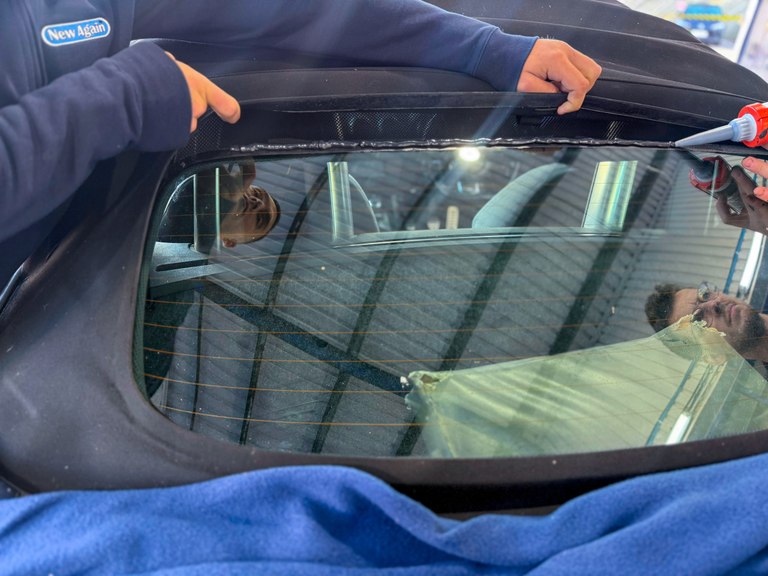
Matt, our workshop manager, does this job start to finish, using a structural adhesive chosen for its heat resistance rather than a generic sealant. Both bonding surfaces are cleaned and primed, then a temporary seal of thin sealant bonds and aligns the window while suction cups compress it in place. Once the leading edge has fully bonded, we trim the excess sealant, run a neat bead around the affected area, and finish it so it sits cleanly against the fabric. The adhesive needs proper time to cure and be tested before the roof goes back into use, so this is not a while-you-wait job; we’ll usually need the car with us for three days.
We’re honest about where our own work ends. At New Again we handle cleaning and weatherproofing, this rear window rebond, minor repairs to rubbers and trim, and water-leak diagnosis, which is often how a lifting rear pane gets found in the first place, when somebody brings us a damp boot and assumes it’s a seal. For mechanism repairs and full roof replacements, we still point people to Cayman Autos.
What it costs
The rebond is £350 with a 12-month guarantee. It can be booked on its own, but the fabric around the window needs to be clean, soft and supple for the bond to take properly; a dirty hood may need cleaning first, which we can usually do in the same visit. Full details, including what we’ll need from you beforehand, on our rear window rebonding page.