How Much Does Ceramic Coating Typically Cost?

Quick answer: There isn't really a "typical" figure. Expect upwards of £500 for a new, medium-sized car, and more where the paint needs serious correction. What drives the price is size, condition and preparation; not the ceramic coating in the bottle.
The cost depends more on the condition and size of the car than on the coating itself. Applying the coating is the final stage of a longer process: the car is polished and made as near perfect as is economically viable first. So what you're paying for is the service: polishing and preparation plus ceramic coating, with the preparation often being the larger part. Some companies advertise the coating price without the preparation, which makes them look much cheaper than they really are.
A used car costs more than a new one, a small town car costs less than a mini-bus, and a 3-year coating is cheaper than a 10-year coating. For an accurate quotation we'll need to inspect the car, or at least see good photos and video of its condition.
Is the price "supplied and fitted"?
The first question to settle when comparing prices is whether the quote covers the coating alone, or the full preparation too. Many companies include polishing, decontamination and ceramic coating in a single price; others quote them separately, so when you add everything up, the total is much the same. The difference is easy to miss when you're scanning headline figures.
There are often add-ons listed separately as well. Coating the face of a set of wheels typically runs £80-£120 depending on the coating used. Glass can appear as its own line item too. So the full job (bodywork, wheels and glass) can look quite different from a bare-body figure advertised online.
Why two quotes can look miles apart
Asking "how much for a ceramic coating" with no further detail is a bit like asking "how much for a building extension"; the range is wide for good reason. Two quotes that look miles apart on price are rarely for the same amount of work.
The package is inspection, preparation, polishing, the coating itself, and usually some level of warranty and aftercare. Most of the cost is time, not liquid in a bottle. Cheaper packages save money by cutting time from one or more of those stages; not through a magic cheaper version of the same work. The main drivers are the size and shape of the car, the condition of the paintwork, the colour and softness of that paint, how many hours of machine polishing are needed, and any add-ons like wheels-off coating, glass, interiors or roofs.
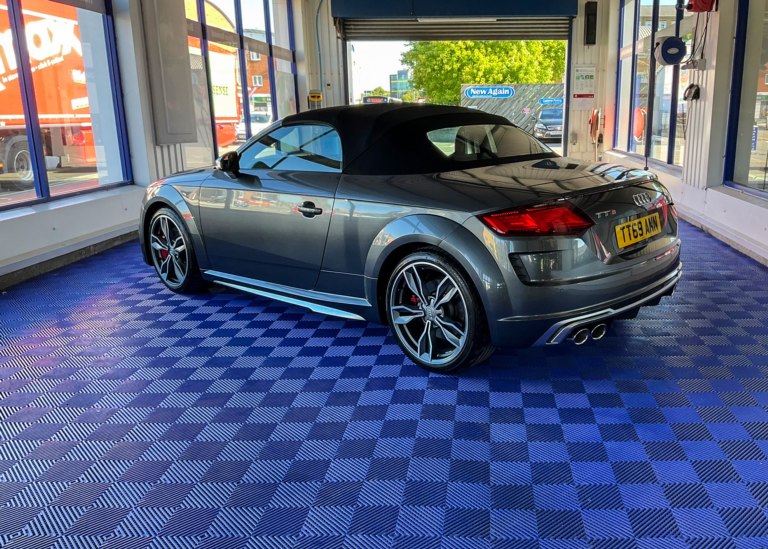
One specific case where we do offer a genuinely lower price: when a coating is bundled with a convertible-roof job we're already doing. The roof work makes the car very messy and needs a full clean afterwards, so the prep work for the coating is mostly already paid for in the roof job. It's a bundle case rather than a from-£X headline, but it's the cheapest real coating job you'll see from us.
Not all ceramic coatings are equal
Durability ranges from three years to ten or more, and the chemistry behind that range varies considerably. A coating positioned as a premium product should command a higher price because it genuinely performs differently: harder film, longer hydrophobic life, better resistance to washing abrasion. The difficulty is that marketing language often obscures the actual chemistry.
A manufacturer approached us not long ago with samples of a product carrying "graphene" in the name. When we asked them directly, they confirmed there was no actual graphene in it: graphene was simply the latest marketing buzzword, their words. The product may or may not have been useful, but the name was pure positioning. That kind of labelling is common, and it means a high-sounding ingredient list is not on its own a reason to pay more.
Very cheap "ceramic" deals are often retail-style sealants or quick dealer packages, not the same as a fully prepared, high-solids professional ceramic coating.
Red flags on suspiciously cheap quotes
Bargains do exist, but some low prices come from cutting corners you won't see on the day.
- Little or no discussion of paint inspection, decontamination or polishing; just "wash and coat".
- Very short booking slots that do not leave enough time to do everything promised on the menu.
- Coatings sold as "lifetime" or "permanent" with no mention of inspections, aftercare, or what happens if there is a problem.
- Heavy reliance on buzzwords (nano, titanium, graphene) but vague answers when you ask what preparation is included.
One customer was offered a coating by the dealership when buying his new car and asked us to price-match. We couldn't, so he went with the dealer. He was happy for a few months, then came back to us to have it done properly; by which point we saw very little evidence the car had ever been coated at all. Buy nice, or buy it twice.
The accreditation system and what it means for price
Most reputable ceramic coating brands operate an accreditation scheme. The applying technician has been trained to the brand's standard, the workshop has been assessed for lighting and environmental control, and the installer carries the brand's warranty. The practical result is that price tends to be standardised across accredited installers for any given product: you won't find one accredited applicator undercutting another by 40% on the same coating. If a price is dramatically lower, the most likely explanations are that the preparation is shorter, the product is different, or the installer is not actually accredited.
A recognisable brand name on the invoice is meaningful precisely because accreditation enforces a floor on what the job includes. The goal is making sure you are paying for a quality coating and professional service, not just a well-marketed bottle.
How to compare quotes fairly
- Ask for a written breakdown of what is included: inspection, preparation, how many stages of polishing, what is coated, and which products are used.
- Check how long the car will be with them and how that time is split between preparation, polishing and coating.
- Look at photos or, better, real cars they have coated and how the finishes look in daylight, not just under soft showroom lights.
- Read the warranty and aftercare information so you know what you are expected to do, and what help you get if something goes wrong. Favour an accredited installer using a recognised coating system.
How much should you actually spend?
The right spend depends as much on your plans for the car as it does on the chemistry in the bottle. If you will keep the car for many years and can't stand swirl marks, thorough correction and a strong coating usually pay back over time through durability and easier washing. If the car is on a short lease or due to be sold soon, a lighter package (or even a good non-ceramic protection) may be more sensible. If funds are tight, it's often better to put budget into careful machine polishing and a solid mid-range protection than stretch for a premium label with minimal preparation. Whatever level you choose, safe washing and periodic maintenance are what ultimately protect the sacrificial layer you have paid for.
Framed this way, the useful question is less "what's the going rate for ceramic" and more "what level of preparation and protection will keep this particular car in the condition I want, for the years I plan to own it."