Why is ceramic coating so expensive?

Quick answer: The coating material is a small part of the cost. What you are paying for is the service -- surface preparation, machine polishing and a controlled environment. That labour is where most of the money goes.
The coating itself is usually not that expensive. When you buy a ceramic coating, you are buying the service. The same chemistry that protects your paintwork also goes on concrete and glass in skyscrapers -- and the construction industry certainly isn't paying £60 for 80ml. What changes the price is the hands applying it, the preparation the surface needs, and the controlled environment required to do the job properly.
There is also risk involved. Things don't often go wrong, but when they do, putting them right can be time-consuming and expensive. A minor mistake might mean hours of polishing with coarse compounds; a serious one could end with the car being resprayed. In every business, something goes wrong sooner or later, and that cost has to be accounted for.
Three jobs come to mind where prep ended up far heavier than the quote anticipated. A Volvo we expected to wash off easily turned out to have tree sap that had etched every upper surface; the bonnet, roof and boot lid all needed wet-sanding and re-polishing, and we ended up absorbing most of that extra time rather than pushing it onto the customer who'd already agreed a fixed price. A Porsche 911 came in with what we thought was a small rust mark; investigating it properly led to welding and a panel repaint at the bodyshop. And a camper van imported from Japan looked straightforward until we started polishing it and found the paint was unusually soft -- "sticky", in the trade -- because Japanese paint formulas are different from European ones. We had to phone a specialist in Japanese imports to find out which pads, at what speeds, with which compounds would polish that paint without leaving buffer marks all over it. None of that was foreseeable at the quote stage; all of it is the kind of thing the prep budget on every coating job has to cover.
The way we handle it in the workshop: when we find work mid-job that we couldn't see at the quote stage, we call the customer. Small bits we absorb; significant extra work gets explained, priced, and only goes ahead if they say yes. Quietly walking away from a car that needs more work isn't fair to anyone, but neither is calling mid-job to ask for a much bigger sum than was originally agreed. Transparency is the version we've settled on.
Why preparation adds so much to the bill
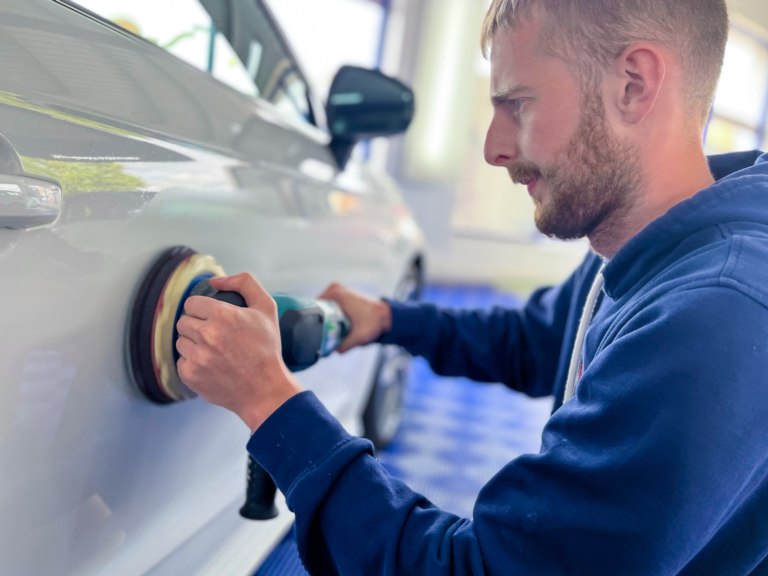
The single biggest chunk of cost is the polishing work that happens before the coating ever touches the paint. Iron fallout, tar, old waxes, and dealer sealants all have to be removed first through decontamination, otherwise the coating just bonds to whatever's sitting on top of the clear coat rather than to the paint itself. Even new cars usually need a light machine polish to remove transport marring, holograms, and the kind of light defects you see in workshop lighting but not in a brochure. Darker and softer paints often need extra refinement to remove haze and buffer trails before you can lock everything in. It's slow, detailed work in a clean, well-lit bay with the kind of bright inspection lighting that reveals polishing haze and high spots before you take the car home; if any of it is rushed or skipped, the coating preserves every swirl and sanding mark in the clear coat rather than locking in a finish worth preserving.
Tom shows us this Porsche 911 Carrera -- a good example of how prep can outgrow the original estimate. Under our workshop lights the scratch count was significantly higher than either side expected, and the car needed a 4-stage machine polish before any coating was applied.
The flash-off window
Once the coating is down, the margin for error is real. After applying it we wait for it to flash off, then -- depending on temperature and humidity -- we have roughly 10 to 15 minutes to remove it. On a hot day that window closes considerably; on a damp day the coating can dry unevenly, which is exactly why it has to be done inside in a controlled environment.
Remove the coating too soon and it can be patchy. Leave it too long and it goes hazy. And if either happens, ceramic is permanent: you can't wash it off and start again. Correction could mean hours of polishing or, in the worst case, a respray. That risk sits with whoever applies it -- and it's part of what you're paying for when you book with a professional.
Why professional-grade coatings cost more
The coatings themselves vary in cost too. A genuine high-solids professional product isn't the same chemistry as a spray labelled "ceramic" on a retail shelf. Many pro coatings are only supplied to accredited installers who've been through training and follow set procedures, and the manufacturer keeps that filter in place to protect the product's reputation. The chemistry is tuned for longevity and chemical resistance rather than ease of use in any conditions. And reputable brands back their products with technical support, warranty systems, and compatible aftercare -- which all carries cost the bottle price absorbs. More expensive doesn't always mean better, but the coatings that can genuinely protect a car for years are neither cheap to buy nor easy to use.
Why restricted supply is good for the customer
The ceramic coating industry learned from what happened to older polymer sealants. Those products were genuinely good -- we still rate them for the right applications -- but their reputation took a battering. A significant part of the problem was the dealer channel: products would fall off the back of a lorry between the storeroom and the customer, ending up on eBay at a fraction of trade value and applied by people with no idea how to use them. Dealerships compounded this by paying low rates for application, with predictable results for quality.
The internet did the rest. Car enthusiast forums filled up with people telling anyone who'd listen that dealer sealants were worthless and the real answer was whatever they'd just bought from Halfords. That reputational arms race didn't reflect the product; it reflected poor application and poor supply control.
Ceramic companies took note. They vet who is allowed to apply their products: premises, controlled environment, the right equipment, and a training course you have to pass. They'll withdraw approval from an installer who can't deliver. The practical result for you as a customer is that if you're buying a reputable brand of ceramic coating, you can only get it from a reputable installer. Restricted supply isn't artificial scarcity; it's quality assurance built into the distribution model.
For what it's worth, we've been applying polymer sealants and coatings for over 30 years and have never had a warranty return on our own work. We've acted as troubleshooters for coating companies and fixed failed applications done elsewhere -- so we know it happens. The pattern is always the same: application failure, not product failure.
When you do not necessarily need the top package
- Short-term lease cars may not justify multi-day correction and the most exotic coating variants.
- Lower-value or hard-worked vehicles might do better on a simpler protection package and good washing, rather than chasing show-car perfection.
- If you are realistic about seeing a few marks and only keeping the car a couple of years, a more modest coating or polymer sealant may be enough.
- Budget can sometimes be better spent on smart repairs and wheel refurbishment first, before upgrading the chemistry.
A good detailer should be happy to explain different packages and steer you towards the one that makes sense for your plans, not the most expensive one.
How to decide if the cost is justified for you
- If you keep cars for years, dislike swirl marks and want easier washing, a proper coating package often works out cheaper than repeated correction and waxing.
- If you change cars frequently or are relaxed about light marks, lighter protection may be more sensible and cheaper overall.
- If a quote seems high or low, ask for a breakdown of the time spent on preparation, polishing and coating so you can compare like with like.
- Factor in how you will wash and maintain the car afterwards, because that is what ultimately protects your investment.
Seen this way, a ceramic coating isn't just an expensive bottle of liquid. It's a labour-intensive process that, done properly, buys you years of easier maintenance and better-looking paint.