What is Aqua-Wax?

Quick answer: Aqua Wax is a spray-on wax used on a freshly washed, still-wet car. Mist it onto wet panels, spread with a damp microfibre and dry off; it leaves a slick, glossy, hydrophobic layer in one pass. It is quick, easy and perfectly safe over a ceramic coating -- but its durability is measured in weeks, not years.
"Aqua Wax" started life as a single AutoGlym product, but the name has slipped its moorings. These days people use it for the whole category: any wax-type product you spray onto a wet car after washing and then buff off as you dry. If you have ever watched a valeter blitz a forecourt of cars at speed, you have almost certainly seen one of these in action.
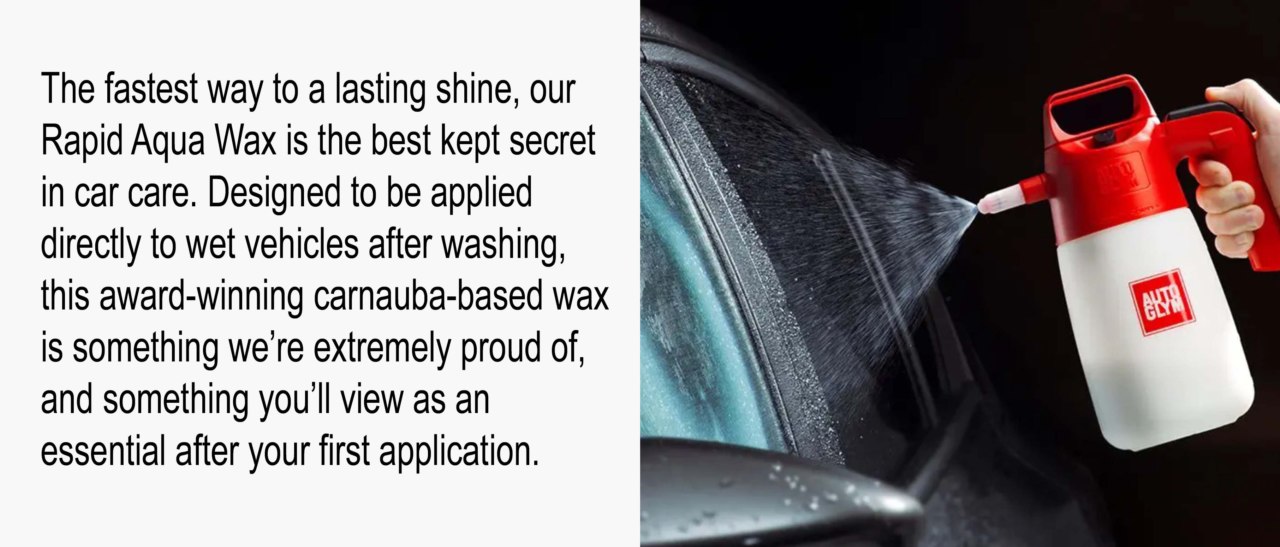
How it actually works on the car
The clever bit is the chemistry being tuned for a wet panel rather than a dry one. A traditional paste or liquid wax wants a clean, dry surface; smear it onto wet paint and it sulks. An aqua wax is the opposite. You wash the car, leave it dripping, then mist the product over a panel and spread it with a wet microfibre. As you wipe the panel dry, the carrier flashes off and the polymers and waxes left behind bond to the paint. One pass: dried and waxed at the same time.
Most aqua waxes are blends of synthetic polymers, natural or synthetic waxes and surfactants. The surfactants are what let the product sheet and spread evenly over standing water instead of beading up and dragging. The result is a slick surface, a noticeable lift in gloss, and water that beads and runs off rather than sitting in flat sheets -- the hydrophobic behaviour people associate with a freshly waxed car.
It is genuinely one of the quickest ways to wax a car, which is exactly why it caught on in the trade. Contract valeters might clean and protect thirty cars in a day; nobody is hand-applying carnauba paste under those conditions. There is a long-standing trade favourite, bright orange and almost universally nicknamed "Tango", that does the same job. The finish goes on across paint, glass, chrome, plastic trim and rubber without fuss, and that all-surface forgiveness is part of the appeal.
The trade-off nobody hides: durability
Aqua wax does not last. A typical coat is good for a couple of weeks of weather, maybe a month if the car lives in a garage and does gentle mileage. That sounds like a flaw until you understand the assumption baked into the product: you are going to wash the car again soon, and when you do, you will simply reapply. The protection is designed to be topped up every wash, not to soldier on for a season.
That is what makes it a close cousin of wash'n'wax. Both treat protection as something you renew constantly rather than something you install and forget. The difference is mainly where the product sits in the routine -- wash'n'wax goes in the bucket, aqua wax goes on after the rinse -- but the philosophy is the same: little and often.
It is also, broadly, what gets pumped through automated car washes. Select "hot wax" or whatever the gantry calls its top tier and you are getting a dilute version of this kind of chemistry, flung at the car and rinsed before it can do much. The effect is real but fleeting, which is why your car looks great driving off the forecourt and ordinary again by the weekend.
Aqua wax over a ceramic coating
This is the question we get asked most often, usually by someone who has just had a coating applied and wants to know if their old habits will hurt it. The short answer: no, an aqua wax will not damage a cured ceramic coating. It is a mild, wax-based product going onto an inert, fully hardened surface. Use it if you like the look.
The longer answer has a wrinkle worth knowing. The wax film you lay down sits on top of the coating, and while it adds nothing to the coating's life, it can quietly mask how the coating itself is performing. We saw this clearly on a customer's car last spring: he had a coating we had applied eighteen months earlier and was convinced it was "still beading beautifully", so we were puzzled when a quick water test in the workshop looked flatter than expected. It turned out he had been aqua-waxing it every wash. The beading he loved was the wax doing the work; the coating underneath had wandered into the part of its life where it needs a decontamination wash and a maintenance top-up, and the wax had hidden that completely.
So the honest position is this: aqua wax over a coating is safe and it looks good, but it is cosmetic. It does not extend the coating, and if you layer it on every wash you lose your ability to read the coating's real condition. If you have spent money on a coating specifically to know it is protecting the paint, occasionally washing without the wax -- and watching how the bare coating beads -- tells you more than any amount of topping up.
Doing it well, and where it goes wrong
For all its forgiveness, aqua wax is not entirely idiot-proof, and the failure modes are worth knowing because they are the same ones we see on cars that come in looking streaky.
The product needs a genuinely wet panel to spread on. Work it on a panel that has already dried in the sun and you get smearing and drag, because there is no water film to carry it. Work in direct sunlight on a hot panel and the carrier flashes off too fast, leaving hazy residue you then have to buff out -- which defeats the point of a one-pass product. And the cardinal sin: spraying it onto a car that has not actually been washed properly. Aqua wax is not a cleaner. Mist it over road grime and you are dragging that grit across the paint with your cloth, putting in exactly the kind of fine swirl marks that send people to us for paint correction later.
Used as intended -- on a properly washed, still-wet car, out of direct sun, with a clean microfibre -- it is fast, cheap and gives a lovely short-lived shine. Misused as a shortcut to skip the wash, it is a swirl-marking machine.
Where it sits among the options
It helps to think of paint protection as a ladder rather than a single right answer. Aqua wax and wash'n'wax live at the bottom rung: minimal effort, minimal cost, minimal durability, renewed constantly. Traditional paste waxes sit a little higher, lasting weeks to a couple of months for more application effort. Synthetic sealants push that to several months. Ceramic coatings sit at the top, trading a careful professional application for years of durability and a hardness no wax can match.
None of these is "wrong". A weekend enthusiast who enjoys washing the car every Sunday and likes a quick gloss top-up is perfectly served by an aqua wax, and spending coating money on that person's car would be overkill. Someone who wants to wash less, worry less and keep a long-term car looking sharp for years is the natural coating customer. The mistake is only ever applying the wrong tool to the wrong expectation -- expecting an aqua wax to "protect" a car for a season, or expecting a coating to need topping up every wash.
For a fuller comparison of where these options land and what genuinely outperforms a wax, see is there anything better than a ceramic coating?