What is quick detailer?

Quick answer: A quick detailer is a spray used between washes to lift light dust and fingerprints while boosting gloss and slickness. It is safe over waxes and ceramic coatings, adds short-term hydrophobicity, but it is not a substitute for a proper wash or for long-term protection.
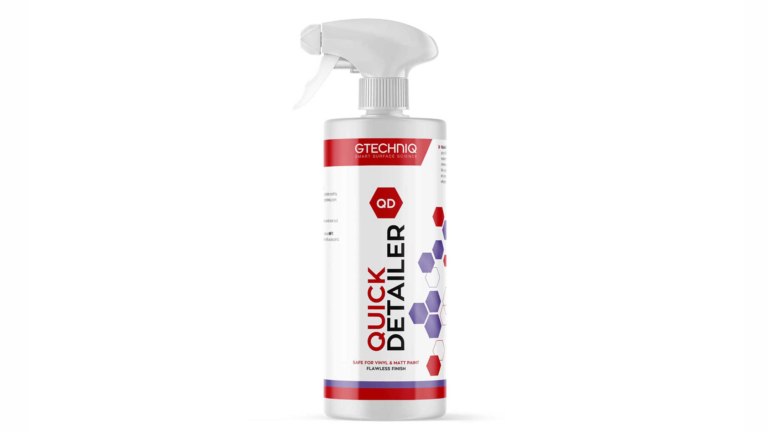
A quick detailer (often shortened to QD) is a spray-on, wipe-off product that sits somewhere between a wax and a wash. You mist it onto a panel, it lubricates the light dust and fingerprints already sitting there, and a clean microfibre lifts that grime away while leaving a film that flatters the paint. The result is a quick hit of gloss and slickness with no bucket, no hose and no drying. That convenience is exactly why it gets misused, so it is worth understanding what the product actually does before you reach for it.
What is actually in the bottle
Most quick detailers are a blend of three things: mild surfactants that lubricate and lift light soiling, a slickness agent (commonly a silicone polymer or a small dose of silica), and a fast-flashing solvent or water base that carries the lot and evaporates quickly so you are not left chasing streaks. The silica-rich "ceramic" QDs that have appeared in recent years lean harder on the polymer side and claim to top up hydrophobicity; in practice that top-up is real but short-lived, measured in a few washes rather than months.
None of that adds up to protection in any meaningful sense. A QD is a finishing and maintenance product. It makes a clean car look better and helps a freshly washed panel bead up again, but it does not lay down a durable barrier the way a ceramic coating or even a decent wax does.
Why it splits opinion
Quick detailers are a little controversial, and the criticism is fair when the product is asked to do the wrong job. Plenty of detailers argue you cannot wipe a dirty panel without dragging grit across the clearcoat and introducing micro-marring, those faint swirl-like scratches that only show up under direct sun or LED light. They are right about the failure mode: a QD has nowhere near enough lubrication to safely shift the gritty road film that builds up over a week of driving.
Where the argument falls down is in treating the worst-case as the only case. Used on a panel that is genuinely clean, or to deal with one isolated bit of mess, a QD is a sensible tool. The skill is honestly judging how dirty the paint is before you spray. If you would not run a bare finger across it without wincing, it needs a wash, not a detailer.
Quick detailer or waterless wash: not the same thing
The two get used interchangeably, and they should not be. A waterless wash is formulated for the job a QD is not: it carries a much heavier load of lubricating polymers and encapsulating surfactants designed to wrap around grit so it lifts cleanly rather than grinding into the clearcoat. You flood the panel, give the chemistry a moment to do its work, then wipe with a plush microfibre and flip to a dry face. It is built to remove a genuine layer of light-to-moderate road film on a car that has no access to a hose.
A quick detailer carries a fraction of that lubrication. It is a finisher, tuned for slickness and gloss on paint that is already clean, not for shifting soiling. Reach for a QD when the car is clean and you want it tidier or shinier; reach for a waterless wash when the car is lightly dirty and a proper contact wash is not an option. Use a QD as a waterless wash on a genuinely grubby car and you are back to dragging grit, which is precisely the scenario the critics describe. The honest test is the same in both cases: how much is actually sitting on the paint, and does the product in your hand carry enough lubrication to move it safely.
When a quick detailer earns its place
There are a few jobs a QD does genuinely well. It is useful when no water is available -- a car kept on the street, a flat with no outside tap, a show car you do not want to soak on the morning. It is a tidy way to lift fingerprints, light dust and fresh smears off an already clean car before photos or a meet, which is where the show shine reputation comes from. And it handles the small emergencies: a single fresh bird dropping, tree sap, or a splash picked up out and about that you want off the paint before it etches.
For that last reason we tell people to keep a bottle and two clean microfibres in the boot. Fresh bird mess is acidic and will start marking a clearcoat within hours in warm weather; flooding it with QD, letting it soak, and lifting it gently does far less harm than leaving it to bake. Just do not let the boot bottle become your only cleaning routine.
Using one without marring the paint
The technique matters more than the brand. Work one panel at a time and out of direct sun so the product does not flash before you have buffed it. Mist lightly; a QD should look like a thin damp veil, not a dripping coat. Use a clean, plush microfibre to spread and lift, then a second dry cloth to buff to a clear finish. The moment a cloth picks up visible dirt, fold to a fresh face or swap it out entirely, because that is exactly when a loaded cloth starts dragging grit. On a larger car you can easily go through three or four cloths, which tells you something about how little soiling each face can safely hold.
That cloth count is the honest catch with the "waterless" appeal. People imagine one bottle and one rag replacing a wash; the reality on a dusty car is a fistful of microfibres and a careful, panel-by-panel pass that takes longer than people expect. Done properly it is safe. Done lazily, with one cloth and a dirty car, it is precisely how the swirl marks the critics warn about get put there in the first place.
Quick detailers over a ceramic coating
A QD is safe over a cured ceramic coating, with one timing caveat: leave it well alone during the first few days of cure on a freshly coated car, while the coating is still hardening. After that it will not harm the coating, but the bottle has to be coating-compatible. Older carnauba-based "spray wax" detailers can leave a film that fights with a silica coating rather than sitting cleanly on top of it; a modern silica or polymer QD labelled as coating-safe is what you want, and Tom, our operations manager, keeps the workshop maintenance shelf stocked with exactly that rather than whatever spray wax is on offer at the time.
The thing to watch beyond compatibility is residue. Heavy or repeated use of a silica-rich QD can build a thin film that masks how the coating underneath is actually performing, so a coating that looks like it is still beading may just be wearing a layer of detailer doing the work. We have seen this on a customer car that came back for a check at the eighteen-month mark: the owner had been misting a ceramic QD on after every wash, the beading looked textbook, but a quick wipe with a panel-prep spray stripped that film and revealed the coating underneath was tiring exactly on schedule. The detailer had been flattering it, not protecting it. If you want the longer version, we have written it up separately in can I use quick detailer over a ceramic coating?
Where it sits in a sensible routine
Think of a quick detailer as a finisher and a spot-fixer, never a substitute for a wash and never a stand-in for proper protection. A good routine is a safe contact wash to remove the grime, a durable layer underneath -- wax or, better, a ceramic coating -- to make the paint easy to clean and slow to mark, and a QD on top for the in-between tidy-ups and the occasional emergency. Get that order right and a quick detailer is one of the more useful things in the cupboard. Lean on it to do the heavy lifting and it quietly works against you.