- Home
- Knowledge Base
- Glossary
- Buffer Trails
Buffer Trails

Quick answer: Buffer trails are the curved, streaky marks left in paint by poor machine polishing, where fine scratches follow the path of the polisher and show up as ghostly lines in strong light.
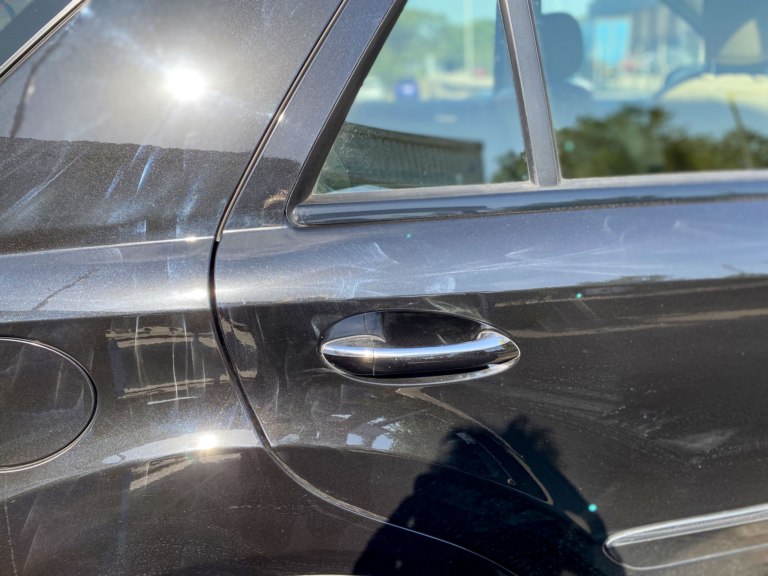
Buffer trails are one of several names for microscopic scratches which can show up on highly polished surfaces as imperfections in the finish. Buffer trails are specifically micro-marring which is introduced as part of the polishing process, and any system of machine polishing will use ever finer abrasives to reduce the micro-scratches by the previous stage until the scratches are so fine they are invisible unless seen under a microscope.
If not done properly, the car will be left with buffer trails, or Rotary Induced Machine Marring. The polishes and compounds used in machine polishes contain oils to act as lubricants, and these oils are very good at filling and hiding micro-scratches. So an essential part of the process of machine polishing is to wipe the car down with alcohol to remove the oils, and then examining the car under harsh light from multiple angles, as buffer trails are often only visible under the right conditions.
Car waxes can hide buffer marks, however more modern coatings do not and may even make them more visible.
What it means
Buffer trails are the marks left behind when a polishing machine has been used in a way that cuts the paint but does not finish it properly. The pad and compound create fine, directional scratches in the clearcoat that follow the movement of the machine. Under sun or an inspection lamp these marks show as shimmery lines or ghosted shapes that move as you walk around the car, often described as holograms.
Why it matters
Buffer trails ruin a finish in a way that only shows when the light is right. A car carrying them can look shiny at a glance, but put it under good light and the surface reads smeared and streaky rather than clean and even. On dark colours they can look worse than everyday wash swirls, more obvious and more artificial, and bonnets and doors tend to show them first.
They are also a giveaway about how the work was done. Heavy trails mean aggressive pads and compounds were used without the refining stages that should have followed, or that the machine was handled badly. That matters practically as well as cosmetically, because waxes, sealants and ceramic coatings lock the trails in exactly as they are. The paint has to be refined before anything goes on top of it.
Spotting buffer trails
Detailing inspections, paint correction quotes and bodyshop quality control reports all name them. Common phrases include rotary buffer trails, holograms on bonnet or machine polishing marks on doors. They show most clearly under petrol station lights, showroom spotlights or bright sun, particularly on darker paintwork.
Context
The two names are not quite interchangeable, which is worth knowing when reading someone else's inspection notes. Buffer trails names a cause: a machine, most often a rotary, has left its own path in the paint. Holograms is the looser word for the same appearance however it got there, and on softer paint that can be a cloth, a sponge or a drying towel rather than a polisher at all. If the marks curve in the arcs of a machine head, buffer trails is the accurate term; if they are simply there and shimmering, holograms is what most people will call them.
Buffer trails sit in the same family as swirl marks, wash marring and hazing, but are more directional and clearly related to machine movement. They are usually created by rotary polishers with wool or aggressive foam pads, used at high speed, with too much pressure or without adequate refinement stages. Modern correction processes typically use a heavier cutting stage where necessary, followed by one or more finishing stages, often with a dual action polisher and fine polish, to remove buffer trails and leave a crisp, even finish. Experienced hands in our workshop can usually spot buffer trails immediately on a dark car under a decent inspection lamp; the tell is that the marks follow curved arcs rather than the random patterns of everyday wash swirls.
Common mistakes
- Using a rotary polisher with an aggressive pad and compound and then skipping the refining stages needed to clear buffer trails.
- Polishing too fast or with too much pressure, tilting the pad on edges and curves so the machine cuts hard and leaves obvious trails.
- Working with dirty or clogged pads that scour the surface instead of refining it, adding fresh trails as you go.
- Applying wax, sealant or ceramic coating over buffer trails and then blaming the protection product for streaks or uneven reflections.