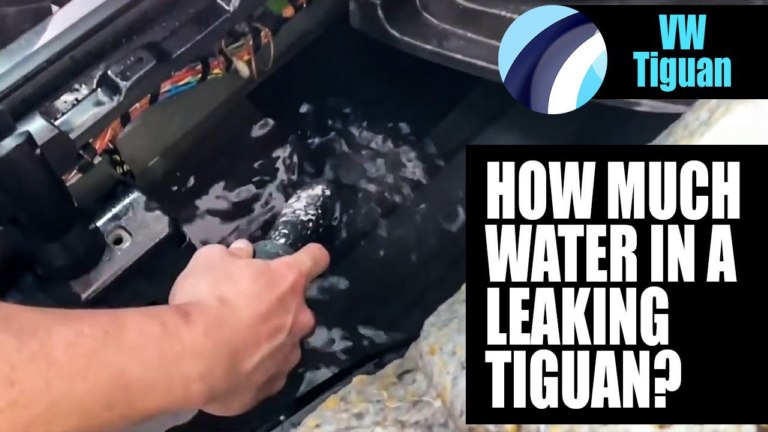
Volkswagen Jetta 2006 | Water Leak Detection Part 1

Video transcript

0:00 We have a Volkswagen Jetta in today, 2006, for our water leak procedure, so we're just going to show you what we've found so far. So if we concentrate on the driver's side sunroof, it's a very common problem with sunroofs being the issue. So what we're going to do is we're going to get our bit of water here, we're going to fill up our reservoir, just like it's out in the rain.

0:21 And then if we then come down by the pedals, we can see that it's actually dripping out onto the pedals and then going on to the carpet. Now the reason that that's doing that is I've removed the A-pillar, and we can see here we have the sunroof drain which goes down. On the Volkswagen they have a connection, and as you can see there the pipes not actually connected into the connector. And so obviously if we connect that up, that will then stop this leak here and

0:52 so normally these shrink, or sometimes they just get dislodged. And we can see there by the marking it should be up to about here. And so that's that one there. And just to show you obviously, on the bottom it's quite hard to see, and but we can see that there is water in the carpet. If I just push the carpet, we can see that there's water there, and there's also water in the driver's rear. And so what I'm gonna do is I'm just gonna quickly lift my hand up, put my hand down

1:23 the back of the carpet, and if I give that squeeze, so we can see that it's damp there. It does smell a bit funky, but that's obviously just because the water's been underneath. And then what we're gonna do is we're gonna go on to the back behind this rear bumper. I've just popped it out a little bit, there's an air vent. Now if we go inside, I've opened it all back up, and what we're going to be focusing on is this air vent just in this section here. So if I can just get

1:53 you in the box section. Right, okay, so what we're going to do is we're going to pour some water on the outside, and what that should then simulate is the water coming through the actual air vent itself and then going on to that underlay, which is obviously surrounding it. So there we go, so it's not a major leak, but we can see it just starting to run off there at the bottom corner. And then what that would do is that would obviously fill up that tray, and then it

2:29 would work its way into the spare wheel holder. So there we go, so that's what we've found so far on this one here. It's not wet on the passenger side, solely on the driver's side. And so there we go.

Oct
15
2021

This car is a very good example of what happens with sunroofs on many makes and models of cars.

In fact, both the leaks on this Jetta are generic problems which happen to practically call cars because all cars are assembled in much the same way.

Around the sunroof is a trough, where water can collect (this is often called the cassette for some reason), from here there are usually two or four drainage holes with silicone pipes which lead down to the front wheel arches. It is seldom the case that these silicone pipes are in one piece, and often they have a connector. Over time, the silicone pipes shrink and shorten, so they can pull off the connectors, or they can just work their way loose. It is sometimes the case that the connectors are made of plastic which perishes, becomes brittle and shatters, so there are a number of things that can go wrong back there in addition to just blocked pipes.

There are generally two things that can go wrong with the rear air vents, they can get dirty and grit and debris can stop then closing properly, or perhaps more common, the plastic and silicone seals become old, shrink or not as supple. These vents are a bit like a one way cat flap, they are a valve with a gate(s) that let air out, but not water in. Usually just a plastic hinge, time can take its toll on them, which is why its often best just to replace them. 

Solution: We will example the sunroof pipes and see if they can be glued back in, if there is a lot of shrinkage, it might be best to buy a new set and replace them, but this is up to the customer to decide.

We will replace the back air vents as this is the sure-fire solution and as the parts are usually available and aren't much money, it's the most cost-effective solution. 

It's worth saying that the parts companies will keep fan belts and brake disks in stock because they are often replaced and in high demand. Some of the parts we wish to replace, which are bits of plastic interior trim, brackets, pipes and connectors,  are often not kept in stock. They need to be ordered, and you never know what the availability is. It can take days or weeks for parts to arrive, especially if they have to come from abroad. Not always, but it can cause complications. 

Question: "I have repaired my leak, but my car is still damp. How long does it usually take for a car to dry out?"

Answer: Unless you actively dry the car, perhaps never. There may be far more water in your car than you realize, and it can get trapped under plastic lined carpets. Generally the best way to do it is to remove the seats and lift up the carpets. There is more advice in the videos below. 

New Again customer reviewsNew Again, rated 4.7 on Google Reviews

Our specialist water leak team is on hand: call us and we can usually give you a steer within minutes.

Let's chat about itLet's chat about it

More about our car water leak service

This video has been tagged in

#VolkswagenJetta #VW

Share this video

Related Videos

Here are some more of our latest #VW water leak found videos