How New Again became one of very few workshops specialising in car water ingress: from detailing roots to a 28-point diagnosis process over 30 years.
New Again has been making cars like new since 1987. For most of those years the work was detailing (buffing, shampooing, paint correction) first as a mobile operation, then from our workshop in Chelmsford as the customer base grew to include main dealers, fleet operators, Essex County Council and the local police. Somewhere along the way, drying cars became part of the job.
It started practically. When we shampooed seats and carpets, customers didn't want their cars back damp. As a static workshop we could run equipment that no mobile detailer could carry: ceiling-mounted vent units that attached to a slightly open window and dried a car overnight. Dealers loved it; their part-exchanges stopped smelling of damp. Insurance companies noticed, and we started taking on vehicles damaged by fire, flood and spillage. That brought formal training: biological hazards, mould, decontamination protocols. We did the compliance work, the photography, the documentation. We had the machines, the chemicals and the paperwork before we had any idea the specialism was coming.
The sunroof that started it
A friend asked us to dry his car. He was convinced his wife had spilled water in the footwell; the carpet was soaking and he wanted it sorted. We got the car in, pulled the seat, and found far more water than any spilled bottle could account for. Gary looked at the sunroof. The drain pipe was blocked. Water had been running silently down the inside of the trim and pooling in the footwell for weeks: not a spillage at all. We unblocked both pipes, dried the car out properly, and sent it back. The drying machines we already had. The wand we used to clear the pipe we already had for something else. As Gary puts it: we had all the gear. We just didn't know yet that we were going to need it.
We added a few pages to the website and were upfront about where we were starting from: we grossly undercharged in those early days, not realising how hard the work actually was. Some jobs took hours; Gary remembers being up late at night trying to work out how water was getting into an imported Ford Mustang, a car that had been in a collision, repaired, but with panels bent just enough that the bulkhead seams were no longer watertight. We narrowed it down to the bulkhead but to confirm it precisely would have meant pulling the engine. That is cost-prohibitive for almost any customer, and we said so. It is rare, but it happens; you can only strip a car down so far, and part of the job is knowing when to stop and be honest about what you have found and what you haven't. It took a long time to develop a system that was close to foolproof, and we make no secret of the fact that we still don't get it right first time every time. Cars do come back, and we find more leaks. We learned the hard way why so many garages simply won't take on rainwater ingress jobs. It is genuinely difficult work, and understanding that is probably what makes us better at it than most.
The Renault Clios that made it a service
What turned a sideline into a proper offering was a pattern we spotted in Renault Clios. The scuttle trough (the channel under the windscreen that collects rainwater) was blocking and spilling into the cabin on a number of them. We fixed three or four before Aaron, who worked with us at the time and happened to own a yellow Clio himself, recognised it immediately. He was involved in Renault owner clubs; word got around. We did a run of them. That cluster of jobs showed us there was genuine demand for a dedicated leak-finding and fixing service, and it cemented our decision to build it properly.
How we find leaks now
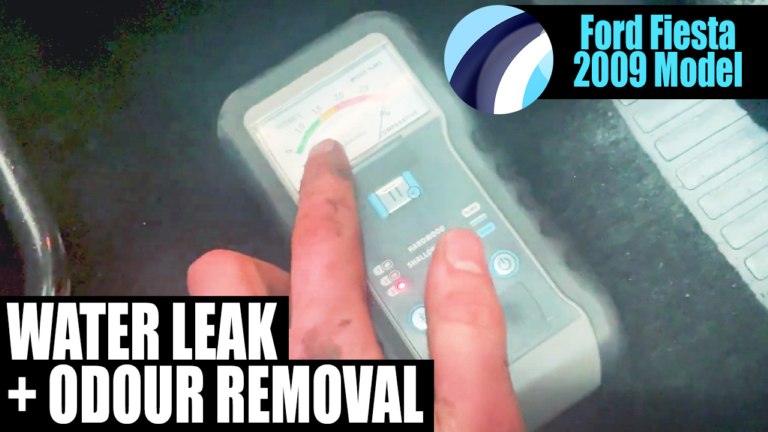
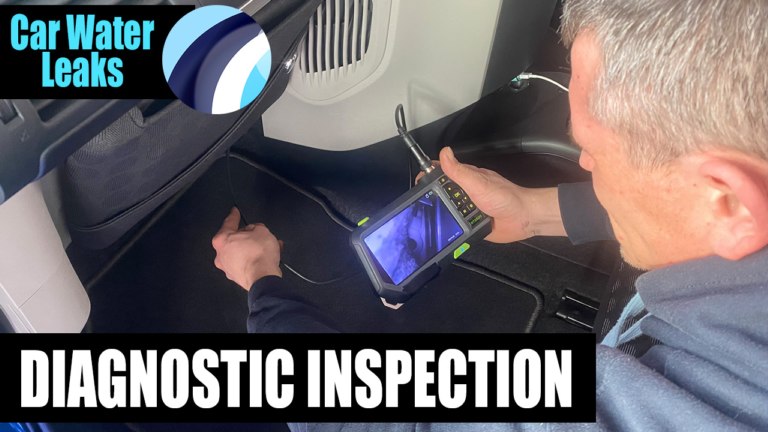
The toolkit has grown considerably since those early days. We use ultraviolet lights with fluorescent dye that we introduce into the water path: if a puddle under the back seat is coming in through the windscreen seal and tracking behind the dashboard before it appears, the dye traces the full route back to the source. Every customer gets a video of what we found; if the dye method located the leak, they see it glowing on camera. We use air pressure and soap solution to identify entry points, sonic detectors: a sound emitter placed inside the car, with a receiver waved around the outside. Sound passes through any gap that water can pass through, even a pin-prick. That said, cars are full of intentional holes for ventilation, so sonic detection has limits; it works best on sealed surfaces like windscreens and boot lid rubbers rather than panel joints, and calibrated moisture meters to map exactly where the saturation has spread. We have also been on enough courses covering mould, bacteria, fungus and viral contamination to deal with whatever a long-standing leak has left behind, and the equipment to eliminate it. You can read more about how we diagnose water leaks on our diagnosis service page.
Drying: why it takes as long as it does
Our car drying service runs on three-phase power: industrial blowers and heaters, not the domestic units you can hire from a tool shop. Even so, how long a car takes to dry depends entirely on what is under the carpet. A small city car (many Japanese and Italian models) often has a thin layer of carpet over a bare metal floor. These dry out quickly. A luxury saloon or SUV can have up to six inches of foam underlay; that takes two to three days to dry thoroughly, and humidity and outside temperature affect the timeline even with the machines running. We generally run them overnight when power is cheaper, but they keep going during the day too. Rushing it causes problems: a car that feels dry at the surface but still has moisture in the foam will start to smell within weeks.
That is the story of how we got here. If you have a wet car (whether you know where the water is coming from or not) our water leak service page explains what we do and how to get in touch.



Share this video